
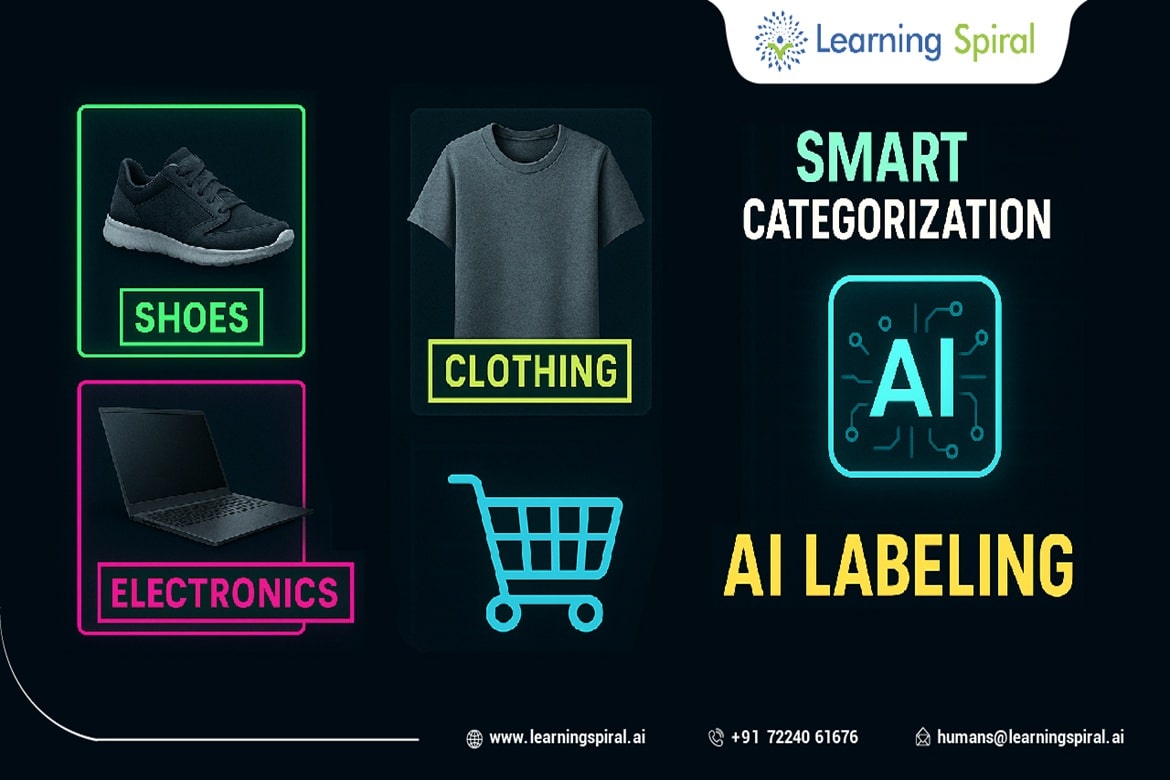
Retail and e-commerce platforms process millions of product images across categories like fashion, electronics, furniture, and FMCG. Customers now expect AI-powered experiences—visual search, smart filters, personalized recommendations, and automated catalog management.
Behind every one of these features lies a critical foundation: categorizing product images accurately.
If images are mislabeled, inconsistently tagged, or poorly structured, AI models struggle to understand products. The result? Broken search results, irrelevant recommendations, and lost conversions. High-quality image categorization turns chaos into usable AI training data.
What Is Product Image Categorization in Retail & E-commerce?
Product image categorization is a form of image annotation where each image is assigned predefined labels or attributes that describe what the product is and how it should be grouped.
Depending on use case, categorization can include:
- Product type (shirt, sofa, smartphone)
- Category hierarchy (men → clothing → t-shirts)
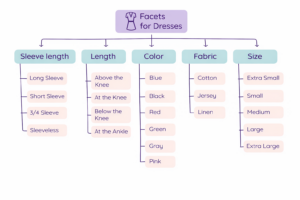
- Attributes (color, pattern, sleeve type, material)
- Contextual tags (on-model, flat-lay, lifestyle image)
Unlike simple tagging, categorization ensures structured, machine-readable data that AI models can learn from consistently.
Why Dataset Quality Directly Impacts Retail AI Performance
AI models don’t fail because of algorithms—they fail because of poor data.
According to industry research, over 80% of AI project time is spent on data preparation, not model building. In retail AI, this problem multiplies due to SKU volume and visual variability.
High-quality categorized datasets enable:
- Accurate visual search and image-based discovery
- Reliable product recommendations
- Faster onboarding of new SKUs
- Reduced manual catalog operations
Gartner reports that organizations improving data quality can see up to 60% improvement in AI model performance, especially in computer vision applications.
Key Use Cases Powered by Product Image Categorization
1. Visual Search & Similar Product Discovery
Customers upload or click an image, and AI retrieves visually or semantically similar products. Accurate categorization ensures the model compares relevant items—not random lookalikes.
2. Smart Filters & Attribute-Based Search
Filters like “red cotton kurti under ₹1,000” rely on precise image-to-attribute mapping.
3. Recommendation Engines
AI systems combine browsing behavior with categorized product visuals to personalize feeds and cross-sell effectively.
4. Automated Catalog Management
Retailers with large inventories use categorized images to auto-populate product listings and reduce manual errors.
Image Categorization vs Other Annotation Techniques
| Technique | Purpose | Retail Example |
|---|---|---|
| Image Categorization | Classify image into predefined groups | Men’s formal shoes |
| Bounding Box Annotation | Localize objects | Shoe region in image |
| Semantic Segmentation | Pixel-level labeling | Fabric vs background |
| Attribute Tagging | Feature identification | Color, texture, pattern |
Most retail AI pipelines use categorization as the first layer, then build advanced annotations on top.
Step-by-Step Product Image Categorization Workflow
Step 1: Define Category Taxonomy
Create a clear, scalable hierarchy aligned with business goals—not just aesthetics.
Step 2: Annotation Guidelines
Establish strict rules for edge cases (bundles, accessories, multi-product images).
Step 3: Human-in-the-Loop Labeling
Trained annotators categorize images while QA teams review for consistency.
Step 4: Quality Control & Validation
Multi-level checks ensure annotation accuracy above 95%.
Step 5: Dataset Versioning & Feedback Loop
Continuously refine categories based on model performance.
At Learning Spiral AI, we follow this enterprise-grade workflow to deliver production-ready datasets for global retailers and AI teams.
Common Challenges in Retail Image Categorization
- Category ambiguity (e.g., tunic vs kurti)
- Visual diversity (angles, lighting, backgrounds)
- SKU explosion during seasonal launches
- Inconsistent brand naming conventions
Without expert annotation teams and clear processes, these issues quickly degrade dataset quality.
How Accurate Categorization Improves AI Metrics
Well-categorized product images lead to measurable gains:
- 📈 Higher search relevance scores
- 🛒 Increased product discovery and CTR
- 🔄 Reduced retraining cycles
- 💰 Better ROI on AI investments
McKinsey notes that personalization powered by strong AI data pipelines can lift retail revenues by 10–15%.
Why Enterprises Choose Learning Spiral AI
At Learning Spiral AI, we’ve helped universities, e-commerce brands, and AI startups transform unstructured image libraries into scalable AI training data.
What sets us apart:
- Domain-trained annotators (fashion, retail, electronics)
- Custom category taxonomies
- Human + AI assisted quality control
- Secure, scalable annotation pipelines
- Proven accuracy benchmarks across millions of images
Visual Dataset Best Practices for Retail AI
- Maintain balanced category distribution
- Include multiple viewpoints per product
- Annotate edge cases intentionally
- Track inter-annotator agreement
- Align labels with downstream AI tasks
These best practices future-proof datasets for model fine-tuning and scaling.
Turn Product Images into AI Growth Assets
Product images aren’t just visuals—they’re data assets. When categorized correctly, they unlock smarter search, personalization, and automation.
At Learning Spiral AI, we help retail and e-commerce teams build high-accuracy, scalable image datasets that power real-world AI success.
👉 Contact us for a free dataset audit or pilot project today.