“What a stunning goal! The goalkeeper had absolutely no chance!”
For a sports fan, this sentence instantly communicates excitement, action, and emotion.
For an Artificial Intelligence model, however, understanding the same statement requires much more than recognizing individual words.
The system must identify the sporting event, understand who performed the action, recognize the emotional tone, and connect the commentary with the appropriate match context.
This is where Sports Commentary Annotation becomes essential.
By transforming spoken and written sports commentary into structured, labeled datasets, businesses can train Natural Language Processing (NLP) models to interpret match events, recognize audience sentiment, generate summaries, and uncover valuable sports insights.
For sports broadcasters, analytics platforms, and AI developers, accurate Text Annotation, Audio Annotation, and Data Labeling can make the difference between an AI system that simply processes words and one that understands the story behind the game.
What Is Sports Commentary Annotation in NLP?
Sports commentary annotation is the process of labeling spoken or written sports commentary with meaningful information that machine learning models can understand.
A single commentary sentence may contain several important elements: the player performing an action, the team involved, the event type, the match situation, the timing, and the emotional intensity of the commentator.
For example, consider the sentence:
“Rahul strikes a magnificent six in the final over!”
An NLP annotation project might identify Rahul as the player, six as the scoring event, final over as the match context, and excitement as the emotional tone.
Once these elements are labeled consistently, the commentary becomes part of a structured Dataset for Machine Learning.
This process builds on Natural Language Processing, a field of artificial intelligence that enables computers to analyze, interpret, and generate human language.
In sports AI, these techniques help convert unstructured commentary into information that can support analysis, search, content generation, and intelligent applications.
Why Does Sports Commentary Need Specialized Data Annotation?
Sports commentary is very different from ordinary written communication.
Commentators use expressive phrases, sport-specific terminology, metaphors, abbreviations, and rapidly changing descriptions of live events.
A football commentator might shout, “He finds the back of the net!” while a cricket commentator could say, “That’s gone all the way!”
Although neither statement explicitly describes every detail of the action, human audiences immediately understand its sporting significance.
An AI model may struggle to interpret such language without sufficient domain-specific training examples.
Through Text Annotation, sports commentary can be labeled according to its meaning, context, entities, and intended interpretation.
This structured approach helps NLP models learn the difference between literal language and expressions that communicate sporting events.
It also supports the understanding of ambiguous words such as “boundary,” “pitch,” “strike,” or “break,” which may have different meanings across sports.
For organizations developing sports-focused AI applications, accurate language labeling is a fundamental requirement.
Key Annotation Techniques Used in Sports Commentary
1. Named Entity Recognition for Players, Teams, and Events
Named Entity Recognition (NER) identifies important entities within commentary.
These may include player names, teams, stadiums, tournaments, coaches, referees, match periods, and other competition-related information.
Consider the example:
“India defeated Australia at the Melbourne Cricket Ground after an outstanding bowling performance.”
Annotation can identify India and Australia as teams, Melbourne Cricket Ground as a venue, and the result as a match-related event.
Accurate entity labeling supports sports search engines, automated match reporting, knowledge graphs, and player-performance analysis.
2. Sentiment Analysis for Emotion and Match Reactions
A sports event is not just about statistics. It is also about emotions.
Excitement, frustration, disappointment, celebration, and controversy often appear in match commentary.
Using Sentiment Analysis, annotated sports text can help AI models recognize emotional patterns.
For example:
“An incredible comeback! What a performance!” may be labeled as positive and highly excited.
“Another disappointing defensive mistake.” may represent negative sentiment.
“The referee has awarded a free kick.” may be classified as neutral, depending on the context.
This work relates to sentiment analysis, where computational methods are used to identify opinions, attitudes, and emotional signals within language.
In sports commentary, sentiment annotation becomes more challenging because strong emotion does not always indicate a positive or negative outcome.
An exciting moment for one team may be devastating for another.
For that reason, labels should distinguish the commentator’s emotional tone from the event’s impact on a particular team or player.
3. Event Classification for Important Match Moments
Event classification helps AI systems determine what is actually happening during a game.
A commentary dataset may include labels for goals, wickets, boundaries, fouls, substitutions, penalties, saves, timeouts, and other sport-specific actions.
For instance, the sentence “The striker sends the ball past the goalkeeper!” might be associated with a shot or goal event, depending on the surrounding context.
A robust annotation workflow should not automatically classify every shot as a successful goal.
Instead, annotators must use contextual evidence and clearly defined rules to distinguish attempts, confirmed outcomes, and uncertain events.
This improves the reliability of AI models designed for match summarization, sports intelligence, and event extraction.
4. Audio Annotation for Live Sports Broadcasting
Much of the most valuable sports commentary exists in spoken form.
Live broadcasts can contain overlapping voices, crowd noise, cheering, whistles, background music, and rapidly delivered commentary.
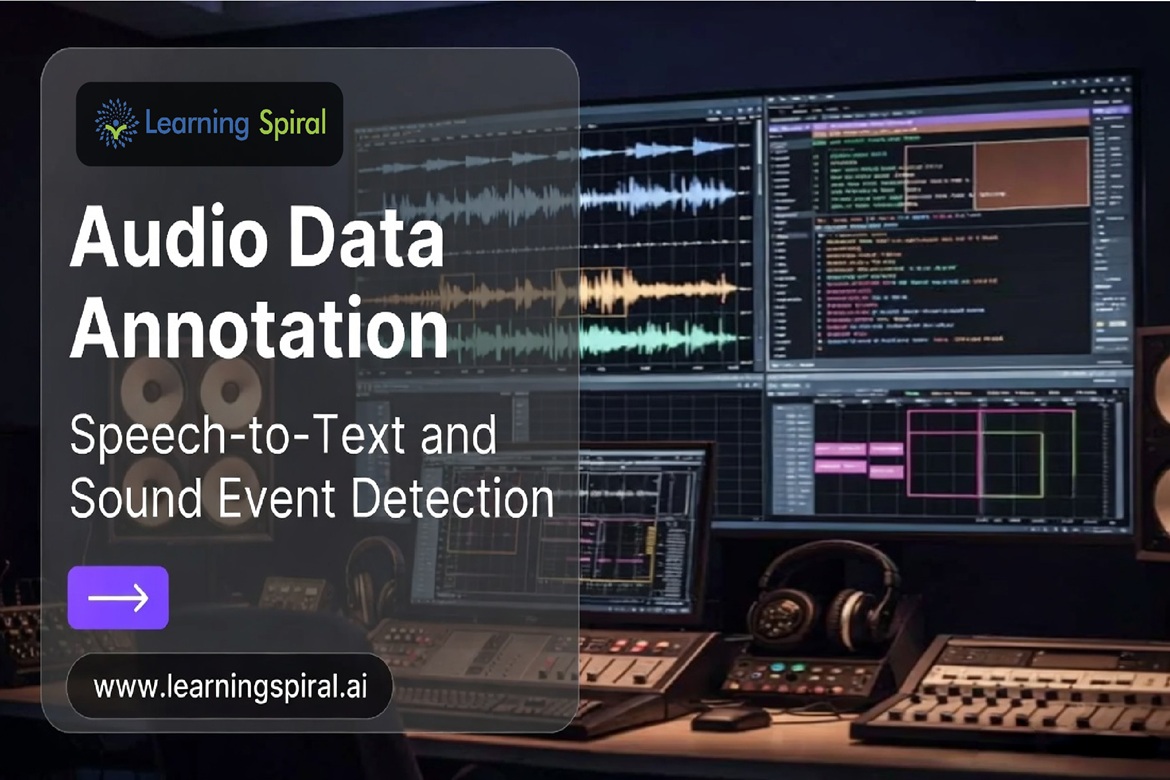
Through Audio Annotation, speech data can be transcribed and enriched with timestamps, speaker labels, language information, and relevant acoustic events.
This helps AI models distinguish a commentator’s speech from stadium noise or audience reactions.
A useful sports audio dataset might contain the spoken phrase, corresponding timestamps, speaker identity where known, event labels, and indicators of transcription uncertainty.
Depending on the project, audio clips can also be connected with video events to improve synchronization between commentary and gameplay.
5. Text Data Annotation for Context and Intent
Understanding sports language often requires identifying meaning beyond individual keywords.
For example:
“He’s absolutely on fire today!”
Without context, an AI system might interpret the statement incorrectly.
Within a cricket or basketball match, however, the phrase may describe exceptional player performance.
With high-quality Text Data Annotation, such expressions can be categorized according to intent, figurative meaning, subject, and sporting context.
This is particularly important for LLM applications trained to summarize matches, answer sports questions, or create natural-language analysis.
How Sports Commentary Becomes an AI-Ready Dataset
Transforming raw commentary into reliable training data requires a carefully organized annotation workflow.
The first stage involves gathering legally usable commentary data from sources such as licensed broadcast transcripts, approved audio recordings, or authorized sports archives.
Next, the commentary is cleaned and segmented into meaningful units.
A long live broadcast may contain thousands of statements, but not every sentence represents a separate sporting event.
The dataset therefore needs a clear structure that distinguishes commentary segments, game events, reactions, and background speech.
Annotators then apply the required labels, including entities, event categories, sentiment, timestamps, and contextual attributes.
For example, a cricket commentary statement might be represented using fields such as:
Commentary: “The batter launches the ball over long-on for six!”
Sport: Cricket
Event: Six runs scored
Action: Batting stroke
Sentiment: Excited
Commentary Type: Live play-by-play
Entity: Batter identity, if established from match context
This structured information allows a machine learning model to learn relationships between language and sporting events.
Following annotation, a quality-control stage checks whether the selected labels are consistent, factually supported, and aligned with project guidelines.
The validated output can then support NLP model training, testing, and evaluation.
Why Human in the Loop (HITL) Matters for Sports NLP
Sports commentary contains expressions that automated systems may find difficult to interpret.
Sarcasm, exaggeration, regional slang, overlapping commentary, and sport-specific phrases can cause labeling errors.
Consider:
“Brilliant! Another easy catch dropped!”
A basic sentiment classifier might interpret the word “brilliant” as positive.
A human reviewer, however, can recognize that the commentator may be expressing sarcasm or frustration.
This is why Human in the Loop (HITL) workflows are valuable for complex sports NLP projects.
Human annotators review ambiguous statements, correct inappropriate labels, and resolve disagreements using established annotation guidelines.
Expert-reviewed examples can also be used to evaluate automated labeling systems and identify recurring errors.
The objective is not to eliminate automation, but to combine efficient processing with informed human judgment.
For organizations working on Data Annotation Projects, this approach can improve dataset consistency and make model-training inputs more dependable.
How Sports Commentary Annotation Powers Real-World AI Applications
Automated Match Summaries
Sports media platforms can use NLP models trained on annotated commentary to identify major match events and support the creation of match summaries.
Rather than analyzing every commentary sentence equally, these systems can prioritize goals, wickets, turning points, and other significant moments.
This can reduce the amount of manual work required to organize large volumes of match information.
Intelligent Sports Search
Imagine a fan searching for “all last-over sixes by a particular player” or “the most dramatic goals in a tournament.”
Sports search systems become more useful when commentary is labeled with relevant players, events, match details, and timestamps.
Structured Data Labeling helps connect natural-language queries with specific sporting moments.
Audience Sentiment and Engagement Analysis
Broadcasters, sports organizations, and digital platforms can use annotated commentary and related reactions to examine emotional patterns surrounding matches.
This may support audience engagement analysis, content recommendations, and the identification of high-interest moments.
However, commentator sentiment should not automatically be treated as representative of fan sentiment. These are different signals that may require separate datasets.
AI-Powered Sports Assistants
An LLM trained or evaluated using suitable sports datasets can help users ask questions about matches in everyday language.
For example:
“Who scored during the final ten minutes?”
“Which player received the most praise during the match?”
“What were the major turning points?”
High-quality annotated commentary can support information extraction, retrieval, and evidence-grounded responses.
Automated Sports Highlight Discovery
Commentary frequently provides useful clues about important moments.
An excited call following a goal, wicket, or match-winning shot can help identify segments worth reviewing.
When commentary annotations are synchronized with Video Annotation and event timestamps, AI systems can combine linguistic and visual signals.
This can support more accurate identification of candidate highlights for sports content platforms.
The Biggest Challenges in Labeling Sports Commentary
Sport-Specific Vocabulary
Different sports use specialized terms that may have completely different meanings in everyday language.
An accurate annotation taxonomy must account for these differences.
Fast-Changing Match Context
A commentator may describe several events in a matter of seconds.
Proper timestamps and context tracking help prevent different actions from being incorrectly merged.
Multilingual Commentary
Sports broadcasts often include multiple languages, accents, and localized expressions.
Multilingual AI Training Data Services can support NLP development by creating consistent labels across different language datasets.
Sarcasm and Figurative Expressions
Not every emotionally intense statement should receive the same sentiment classification.
Human review remains important for statements where the literal wording differs from the intended meaning.
Ambiguous Player References
Commentators regularly use pronouns, nicknames, or shorthand instead of full player names.
Entity linking and context-aware annotation can help associate these references with the correct player.
Noisy Audio Environments
Crowd noise and overlapping speech may affect transcription quality.
Audio data annotation projects therefore need rules for uncertain speech, background sounds, and difficult acoustic segments.
These challenges demonstrate why sports commentary labeling requires more than generic text classification.
How Multimodal Data Annotation Makes Sports AI More Powerful
The future of sports intelligence increasingly involves combining language, audio, and visual information.
A commentator may announce a goal while video frames reveal the player, ball movement, and surrounding game context.
When these sources are accurately synchronized, they can provide richer evidence for AI systems.
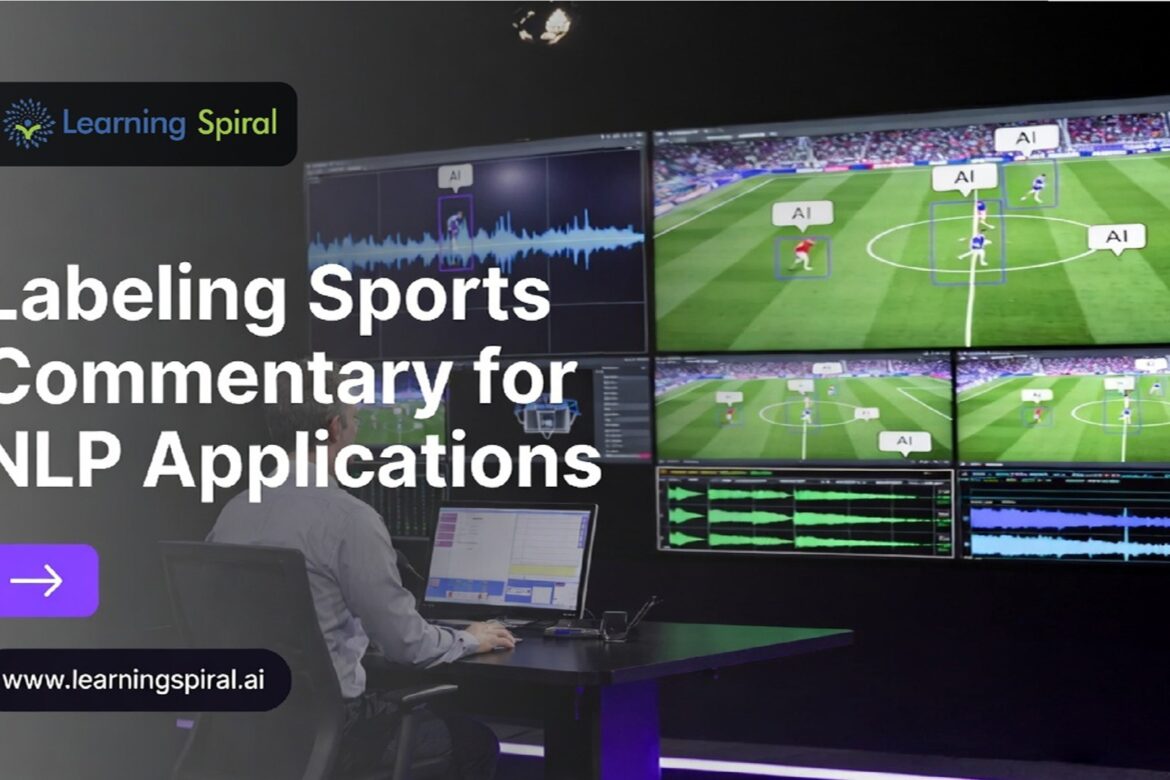
For example, Image Annotation for Sports and Games helps label players, equipment, and sporting actions in visual data.
Video Annotation captures motion sequences and event boundaries.
Audio Annotation provides speech transcripts and timing information.
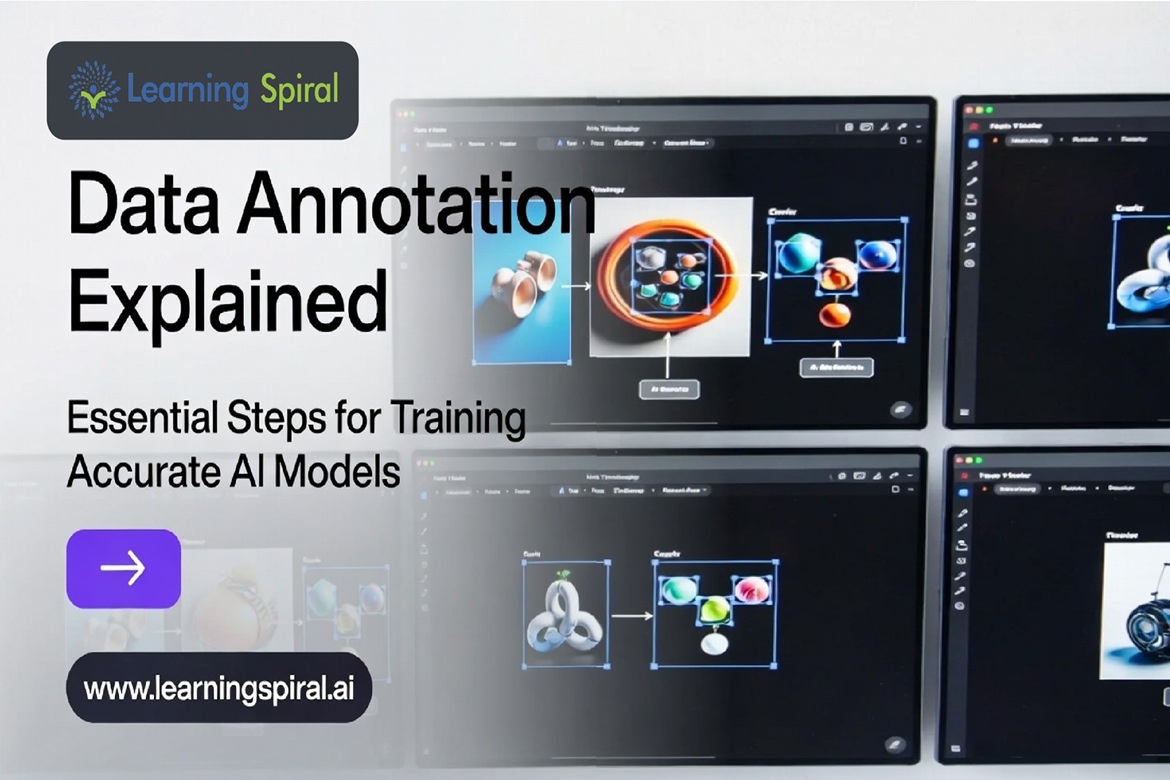
Text Annotation adds language meaning, event classification, entities, and sentiment.
Together, these methods can support sports analytics, automated highlight generation, commentary search, and intelligent content discovery.
Multimodal workflows are especially useful when information from one source is incomplete.
A commentary transcript may confirm an event that is visually obscured, while video evidence may help clarify an ambiguous spoken description.
This coordinated approach makes specialized AI Data Solutions increasingly relevant to sports technology development.
How Learning Spiral AI Supports Sports Commentary NLP Projects
Developing reliable NLP applications requires training datasets built around precise and consistent labeling.
Learning Spiral AI provides scalable Data Annotation Services for organizations building AI and machine learning applications across different industries.
As a Data Annotation Company and Data Labeling Company, Learning Spiral AI supports annotation requirements involving text, audio, images, and video.
Its NLP annotation services include capabilities related to text classification, sentiment annotation, speech recognition, and other language-processing applications.
For sports-focused AI initiatives, these capabilities can be adapted to project-specific requirements such as commentary transcription, entity tagging, sentiment classification, event recognition, and training-data quality review.
Sports technology teams may also benefit from Learning Spiral AI’s related capabilities, including Image Labeling, Bounding Box Annotation, action classification, and visual sports data annotation.
For organizations developing LLM-based sports assistants or automated match-analysis platforms, combining language labeling with carefully structured datasets can create a stronger foundation for reliable AI performance.
Rather than applying a generic labeling method to every assignment, project teams should define the sports taxonomy, annotation instructions, exception cases, and quality checks required for their intended application.
Conclusion: Every Great Sports AI Model Begins with Meaningful Data
Sports commentary is more than a description of what happens on the field.
It captures emotion, context, player actions, tactical decisions, and the defining moments of a match.
But these signals only become useful to AI systems when the underlying data is appropriately structured.
Sports Commentary Annotation bridges the gap between human expression and machine understanding.
Through accurate Text Annotation, Audio Annotation, Sentiment Analysis, and event classification, organizations can transform unstructured sports commentary into valuable NLP training data.
For broadcasters, sports analytics providers, AI startups, and machine learning teams, investing in high-quality Data Labeling Services can help build more useful and context-aware sports intelligence applications.
Because AI should not just hear the game. It should understand what makes every moment matter.
Frequently Asked Questions (FAQs)
1. What is sports commentary annotation?
Sports commentary annotation is the process of labeling spoken or written match descriptions with relevant information such as player names, sporting events, emotions, timestamps, and context so AI models can understand sports language.
2. Why is text annotation important for sports NLP?
Text annotation helps machine learning models identify the meaning of commentary, recognize sports terminology, extract match events, and understand expressions that would otherwise be difficult to interpret.
3. Can sentiment analysis identify emotional moments in sports commentary?
Yes. Sentiment analysis can help classify emotional tone in commentary, including excitement, disappointment, frustration, or neutral reporting. More detailed emotion labels may be needed for sophisticated applications.
4. How is audio annotation used in sports broadcasting?
Audio annotation helps convert spoken commentary into structured data through transcription, timestamps, speaker labeling, and other acoustic or linguistic labels relevant to NLP applications.
5. Can sports commentary annotation improve automated match highlights?
Yes. When aligned with video timestamps and sporting events, labeled commentary can provide useful signals for identifying potentially important match moments.
6. Why choose Learning Spiral AI for NLP data annotation?
Learning Spiral AI provides text, audio, image, and video annotation capabilities with human-reviewed workflows that can support custom AI training-data requirements, including sports-focused NLP applications.
Build Smarter Sports AI with Learning Spiral AI
Looking to develop an NLP application that understands sports commentary, player events, and audience emotions?
Learning Spiral AI provides data annotation and labeling services to support AI developers, sports technology companies, and machine learning teams.