
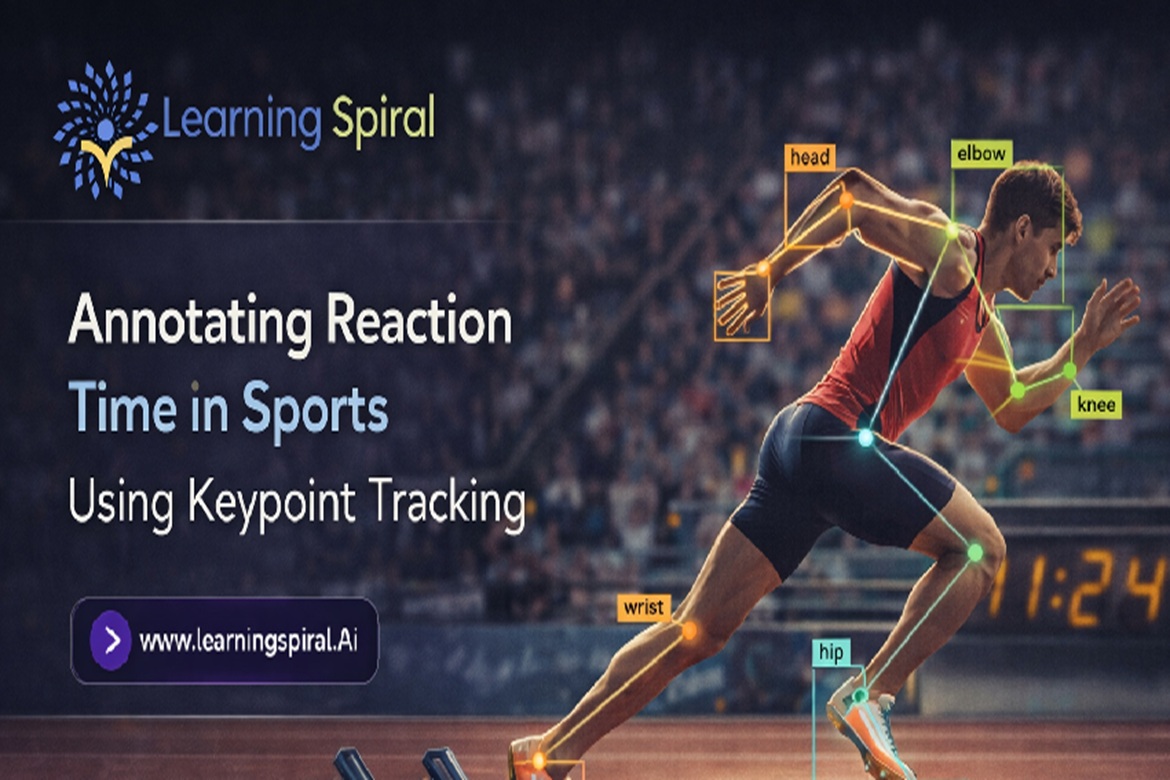
In elite sport, the difference between reacting in time and reacting too late can be measured in milliseconds.
A goalkeeper responding to a penalty kick, a cricket batter picking up the ball after release, a sprinter leaving the blocks, or a tennis player returning a fast serve all depend on one critical capability: reaction time.
For coaches and sports scientists, reaction time has traditionally been measured through controlled tests, sensors, and manual video analysis. Computer vision is changing that process.
With accurate keypoint tracking, Video Annotation, temporal labeling, and motion analysis, ordinary sports footage can be converted into structured datasets that help AI systems understand not only what an athlete did, but also when the response started.
That makes high-quality annotation an essential foundation for the next generation of sports analytics.
What Does Reaction-Time Annotation Actually Measure?
Reaction time is more complex than simply measuring how fast an athlete moves.
For AI analysis, the sequence usually contains at least two important events:
1. The stimulus occurs.
This might be a starting signal, ball release, opponent movement, change of direction, whistle, visual cue, or another predefined event.
2. The athlete initiates a measurable response.
The first meaningful movement may appear in the wrist, ankle, knee, hip, shoulder, head, or another relevant body point depending on the sport.
Accurate data annotation transforms those events into structured labels that a machine learning model can interpret.
Instead of seeing an ordinary video, the model receives information such as:
- Exact stimulus frame
- First-response frame
- Body keypoint positions
- Direction of movement
- Athlete identity
- Action category
- Start and end timestamps
- Movement sequence
- Occlusion status
- Confidence or visibility information
This is where Data labeling & annotation services become important for sports technology companies building automated performance-analysis systems.
How Keypoint Tracking Works in Sports Videos
Keypoint annotation identifies important landmarks on an athlete’s body.
Depending on the project, these may include the:
- Head
- Shoulders
- Elbows
- Wrists
- Hips
- Knees
- Ankles
- Hands
- Feet
Once these points are labeled across consecutive frames, an AI model can learn how the athlete’s body position changes over time.
For example, imagine a goalkeeper waiting for a penalty kick.
The annotation workflow may identify:
Frame A: Ball contact by the striker
Frame B: Goalkeeper begins shifting body weight
Frame C: Lead foot moves
Frame D: Full diving action begins
Tracking the goalkeeper’s hips, knees, ankles, shoulders, wrists, and head across these frames creates a measurable motion sequence.
The time between the stimulus event and the first validated response can then become a reaction-time signal for the model.
This type of Image annotation for sports and games can support increasingly sophisticated sports analytics applications.
Why Video Annotation Matters More Than a Single Image
A single image can show an athlete’s posture.
A video shows change.
That difference is critical when measuring reaction time.
With Video Annotation, annotators can follow keypoints frame by frame and preserve the temporal relationship between a stimulus and the athlete’s response.
Consider a 60-frame-per-second sports video. Each frame represents approximately 16.7 milliseconds.
At 120 FPS, each frame represents about 8.3 milliseconds.
Therefore, even a difference of two or three frames can significantly change the measured reaction interval.
For reaction-time projects, accurate frame selection is therefore just as important as accurate keypoint placement.
From Raw Sports Footage to AI-Ready Reaction Data
Turning sports footage into a usable Dataset for Machine Learning requires more than drawing points on athletes.
A reliable workflow generally follows several stages.
1. Define the Reaction Event
Before annotation begins, the project needs a precise definition of the stimulus.
Examples include:
- Starting gun activation
- Ball release
- Ball contact
- Opponent movement
- Whistle
- Light signal
- Direction-change cue
Without a consistent event definition, annotators may select different starting points for the same action.
2. Establish the Keypoint Skeleton
The project defines which body landmarks need to be tracked.
A full-body movement analysis may require many skeletal landmarks, while a specialized reaction study may need only selected joints.
For example, a cricket batting model may prioritize the head, shoulders, elbows, wrists, hips, knees, and feet.
A goalkeeper-analysis model may place greater importance on the hips, knees, ankles, shoulders, and wrists.
3. Track Keypoints Across Frames
Annotators then label the selected landmarks throughout the relevant sequence.
Consistency matters.
If the left wrist is labeled differently across frames, the model may interpret annotation inconsistency as actual movement.
4. Mark the First Valid Response
This is often one of the most difficult stages.
Small movements caused by balance adjustment, breathing, camera vibration, or natural body sway should not automatically be treated as a reaction.
Annotation guidelines must clearly define what constitutes a genuine response.
5. Add Temporal Labels
Temporal annotation identifies:
- Stimulus timestamp
- Response timestamp
- Action start
- Action end
- Reaction interval
- Relevant event sequence
This creates the connection between body movement and time.
6. Perform Quality Review
Reaction-time datasets benefit strongly from Human in the Loop (HITL) validation.
Human reviewers can identify ambiguous frames, occluded joints, incorrect keypoints, premature response labels, or inconsistent temporal boundaries that automated processes may miss.
Learning Spiral AI applies human-led annotation workflows across complex computer-vision data requirements. More examples of Human in the Loop (HITL) workflows can be seen across physical AI and real-world visual-data applications.
The Biggest Challenges in Sports Reaction-Time Annotation
Sports footage is rarely recorded under perfect laboratory conditions.
Several factors make annotation difficult.
1. Motion Blur
Fast-moving hands, feet, balls, bats, rackets, and other objects can become blurred between frames.
Annotators need clear guidelines for estimating the correct landmark position without creating inconsistent labels.
2. Body Occlusion
Athletes regularly overlap with other players, equipment, or environmental objects.
A football player’s leg may disappear behind another player. A tennis player’s wrist may briefly be hidden behind the torso.
Occlusion labels help the model distinguish between a missing landmark and an incorrectly annotated landmark.
3. Camera Angle Changes
Broadcast sports footage may switch between wide-angle, side, elevated, and close-up cameras.
Datasets designed for computer vision should account for such visual variation.
4. Multiple Athletes in the Same Frame
Team sports introduce another problem: identity consistency.
Tracking IDs are necessary to ensure that the same athlete remains associated with the correct keypoints throughout a video sequence.
5. False Starts and Anticipatory Movement
Not every movement after a stimulus represents a clean reaction.
An athlete may anticipate an event before it occurs.
Projects therefore need rules for distinguishing:
- Anticipatory movement
- Natural posture adjustment
- False starts
- Genuine stimulus-response movement
6. Inconsistent Frame Rates
Datasets collected from different cameras may contain different FPS values.
Reaction time should therefore be calculated using reliable timestamps or correctly normalized frame information rather than assuming every video uses the same recording rate.
Where Reaction-Time Annotation Can Be Used
Sports-focused AI Data Solutions can use keypoint and temporal annotation across many disciplines.
Sprinting
AI models can analyze the interval between a starting signal and the athlete’s first movement from the blocks.
Cricket
Reaction analysis may examine how quickly a batter responds after identifying ball release, direction, or trajectory.
Football
Goalkeepers can be analyzed for reactions to shots, penalties, crosses, and rapid direction changes.
Defensive players can also be studied for their response to attacking movements.
Tennis and Badminton
Keypoint tracking can help analyze preparation, first movement, racket positioning, and response after an opponent contacts the ball or shuttle.
Basketball
Computer vision systems can examine defensive reactions, shot contests, rebounds, passing responses, and changes in player direction.
Combat Sports
Reaction datasets can be used to analyze defensive movement, blocking, footwork, dodging, and counter-movement sequences.
The same underlying annotation techniques can therefore support many Data annotation projects across sports and games.
Reaction Time Is Only One Part of the Dataset
A powerful sports AI system may combine reaction-time information with many other labels.
These can include:
- Player detection
- Pose estimation
- Action recognition
- Object tracking
- Ball tracking
- Equipment tracking
- Event classification
- Movement direction
- Player identity
- Spatial position
- Speed estimation
- Temporal event tagging
This is where a scalable Data Annotation Company can support much more than a single annotation type.
Learning Spiral AI provides Data Annotation Company capabilities across visual, textual, audio, and other AI-training-data workflows.
Why Annotation Quality Can Determine Sports AI Performance
A sophisticated computer vision model cannot compensate indefinitely for inconsistent training labels.
If keypoints move unpredictably because of annotation errors, the model learns unreliable motion patterns.
If different annotators identify different reaction frames for identical scenarios, reaction-time predictions become inconsistent.
If athlete tracking IDs are switched between frames, the motion sequence itself can become unusable.
For this reason, annotation quality should be treated as part of model development rather than a separate data-preparation task.
Organizations evaluating Computer Vision Companies in India and annotation partners should consider:
- Annotation guideline quality
- Annotator training
- Frame-level precision
- Keypoint consistency
- Temporal consistency
- Tracking accuracy
- Multi-stage quality control
- Scalability
- Project-specific customization
Human Review Still Matters
AI-assisted annotation can speed up keypoint placement, tracking, and prediction.
However, complex sports footage contains edge cases that still benefit from human judgment.
For example:
- Was the goalkeeper already moving before ball contact?
- Is that wrist movement intentional or caused by body balance?
- Is a hidden knee positioned correctly?
- Did the tracked athlete change after two players crossed paths?
- Is the selected frame really the first visible reaction?
These decisions can directly affect the resulting dataset.
That is why combining automation with trained human reviewers can be especially valuable for high-precision AI Training Data Services.
How Learning Spiral AI Supports Sports AI Data Projects
Learning Spiral AI supports organizations developing computer vision and machine-learning applications with scalable data annotation services.
For sports and motion-analysis requirements, project workflows can include:
- Image Annotation Services
- Video Annotation
- Keypoint annotation
- Pose labeling
- Object tracking
- Temporal annotation
- Bounding Box Annotation
- Image labeling
- Action classification
- Human-in-the-Loop quality review
- Custom annotation guidelines
- Structured AI training datasets
Depending on the wider AI program, Learning Spiral AI also works across Text Annotation, Audio Annotation, Lidar Annotation, 3D point cloud annotation, Image Annotation for Robotics, and other specialized annotation requirements.
This combination allows teams building sports applications to work with an annotation partner capable of supporting both immediate project needs and broader AI-data requirements.
The Future of Sports Performance Is Becoming Frame-Level
Sports analytics is moving beyond final scores and traditional statistics.
Computer vision can help analyze what happens inside the milliseconds between seeing an event and responding to it.
Keypoint tracking makes those movements measurable.
Temporal annotation makes them interpretable.
High-quality data labeling makes them trainable.
And carefully prepared datasets give AI systems the foundation needed to identify patterns across thousands or millions of athlete movements.
For sports technology companies, research teams, analytics platforms, and AI developers, reaction-time annotation offers another opportunity to transform ordinary video into structured performance intelligence.
When every millisecond matters, the quality of every annotation matters too.
Build Better Sports AI with Learning Spiral AI
Need accurate keypoint tracking, sports video annotation, image labeling, pose annotation, temporal event labeling, or customized AI Training Data Services?
Learning Spiral AI can help transform raw sports footage into structured, quality-controlled datasets designed around your machine-learning requirements.