Artificial Intelligence does not understand an image, video, audio recording, LiDAR scan, or sentence in the way humans do.
Before an AI model can recognise a pedestrian, interpret customer sentiment, identify an abnormality in a medical image, or track an athlete across video frames, it needs structured and meaningful training data.
That is where data labeling and data annotation enter the picture.
The terms are frequently used interchangeably—and there is genuine overlap between them. However, in practical AI projects, data labeling usually refers to assigning classes or categories to data, while data annotation often describes adding more detailed contextual information such as bounding boxes, polygons, keypoints, entities, timestamps, relationships, or segmentation masks.
Understanding that distinction can help AI teams choose the right workflow, control annotation costs, improve dataset consistency, and build better-performing models.
So, Data Labeling vs Data Annotation: what is actually different, and when should you use each?
Let’s break it down.
What Is Data Labeling?
Data labeling is the process of assigning a meaningful category, class, or tag to a piece of raw data so that a machine learning model knows what that data represents.
Think of it as answering:
“What is this?”
For example:
- • A photograph → Dog
- • A customer review → Positive
- • An email → Spam
- • A product image → Footwear
- • An audio clip → Human Speech
- • A video → Football Match
The output becomes a structured Dataset for Machine Learning that can be used by supervised learning algorithms.
A professional Data Labeling Company may handle millions of images, text records, videos, audio clips, or other data points while maintaining predefined labeling guidelines and quality standards.
Common Data Labeling Tasks
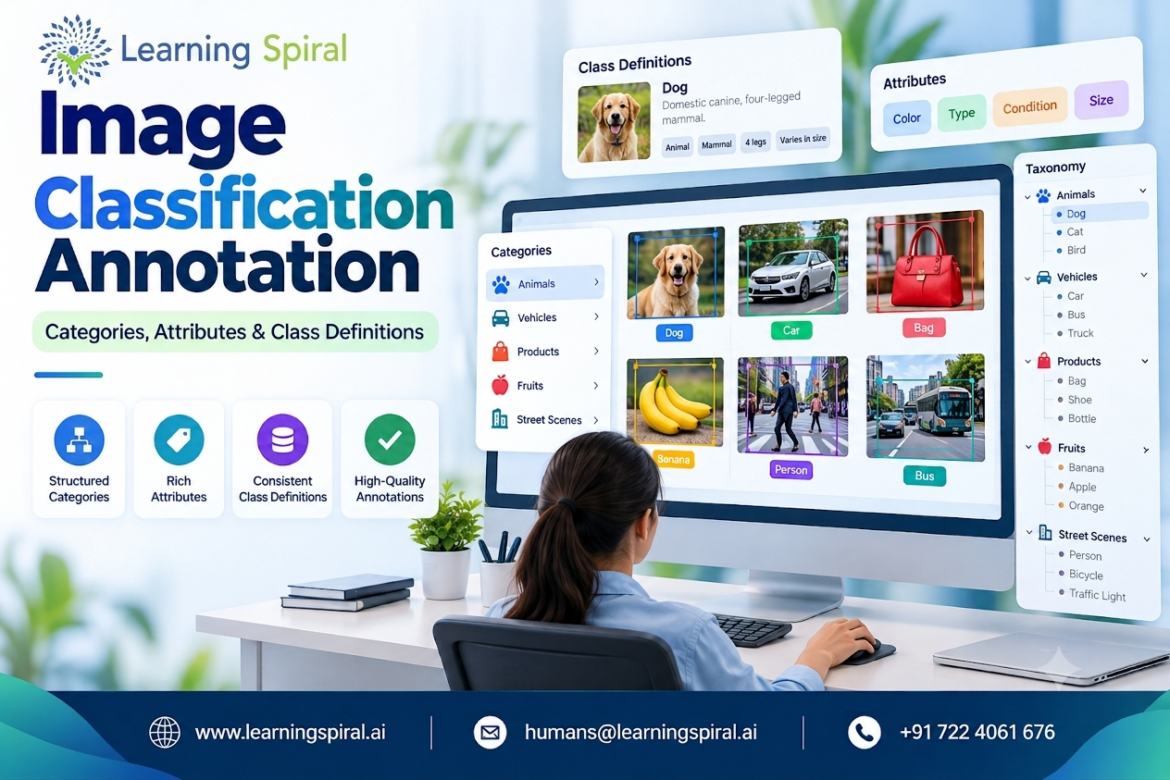
1. Image Labeling
Images are placed into predetermined categories such as vehicle, pedestrian, damaged product, healthy crop, or defective component.
2. Text Classification
Documents, messages, reviews, and conversations can be labeled according to topic, intent, sentiment, urgency, or other classes.
3. Audio Classification
Audio recordings may be categorized according to speaker, sound type, language, emotion, quality, or environmental condition.
4. Video Classification
Entire video clips can be categorized according to events, activities, environments, sports actions, or behaviour.
Labeling is particularly useful when the machine learning model needs a clear answer to which category a piece of data belongs to.
What Is Data Annotation?
Data annotation goes deeper.
Instead of simply telling a model what is present, annotation can tell it:
What is present? Where is it? What is happening? How is it related to other objects?
For example, consider an image containing a car, pedestrian and traffic signal.
Simple image labeling might classify the entire image as:
“Urban Traffic Scene.”
But image annotation could additionally:
- • Draw a bounding box around the car
- • Segment the pedestrian pixel by pixel
- • Identify the traffic signal
- • Mark whether the signal is red, amber or green
- • Define object relationships
- • Identify partially occluded objects
This added detail makes annotation especially important for advanced computer vision, robotics, autonomous vehicles, medical AI and Physical AI applications.
For businesses searching for a specialist Data Annotation Company, the key requirement is therefore not simply “putting labels on data,” but creating accurate, consistent and model-ready training information across image, text, video and audio datasets.
Data Labeling vs Data Annotation: The Core Difference
The easiest way to understand the difference is:
Data Labeling = What is it?
Data Annotation = What is it + where is it + what does it mean in context?
However, this distinction is not absolute.
In the AI industry, the terms frequently overlap. Some teams use “data labeling” as the umbrella term for every training-data task, while others use “data annotation” as the broader concept.
What matters more than terminology is defining exactly what information the machine learning model needs from each data point.
1. Data Labeling Usually Focuses on Classification
Suppose you have 100,000 product images.
If your goal is to classify each image into:
- • Shoes
- • Shirts
- • Bags
- • Watches
then data labeling may be sufficient.
The model primarily needs to understand which category belongs to each image.
This approach is widely used in:
- • E-commerce categorisation
- • Sentiment Analysis
- • Content Moderation
- • Document classification
- • Product categorisation
- • Audio classification
- • Intent classification
2. Data Annotation Adds Granular Information
Now imagine those same product images are being used to train an AI system that must identify exactly where each item appears.
The project may require:
- • Bounding Box Annotation
- • Polygon Annotation
- • Semantic Segmentation
- • Instance Segmentation
- • Keypoint Annotation
- • Attribute Annotation
Here, basic image labeling is no longer sufficient.
The AI model needs detailed spatial or contextual information.
This is where Image Annotation Services become important.
3. Bounding Box Annotation Helps AI Locate Objects
Bounding Box Annotation involves drawing rectangular boxes around objects and assigning a label to each box.
For example:
A road image may contain:
- • Car
- • Truck
- • Bicycle
- • Pedestrian
- • Traffic Sign
Each object receives an individual bounding box.
Bounding boxes are widely used for object-detection applications including:
- • Image annotation for autonomous vehicles
- • Image annotation for retail
- • Image annotation for logistics
- • Security and surveillance
- • Manufacturing defect detection
- • Image Annotation for Robotics
For companies developing vision-based applications, high-quality training datasets are particularly important. Learning Spiral AI also discusses how structured labeling supports Computer Vision Companies in India working across use cases such as object detection, classification, segmentation and LiDAR.
4. Image Annotation Goes Beyond Object Classification
Modern computer vision systems often need much more information than a single image label.
An experienced Image Annotation Company may work with:
- • Bounding boxes
- • Polygons
- • Semantic segmentation
- • Instance segmentation
- • Keypoints
- • Landmark annotation
- • Image classification
- • Object tracking
These methods make Image Annotation Services relevant across very different industries.
For example:
Image annotation for agriculture can help models recognise crops, weeds, fruits, diseases and plant conditions.
Image Annotation for aerial datasets can identify buildings, roads, vegetation, terrain and infrastructure.
Image annotation for retail can support shelf monitoring, product recognition and visual search.
Image annotation for logistics can help identify parcels, pallets, barcodes and warehouse objects.
Image annotation for sports and games can help AI understand players, equipment, movement and game events.
5. Video Annotation Adds the Dimension of Time
An image represents a moment.
Video represents a sequence of moments.
That makes Video Annotation more complex.
Instead of merely locating an object, annotators may need to follow it across hundreds or thousands of frames.
For example, in autonomous driving footage, a pedestrian may:
- Enter the frame
- Move toward the road
- Cross in front of a vehicle
- Become partially hidden
- Reappear
- Leave the camera view
A Video Annotation workflow must maintain the correct object identity throughout that sequence.
Video annotation supports applications such as:
- • Autonomous driving
- • Sports analytics
- • Surveillance
- • Human activity recognition
- • Behaviour analysis
- • Robotics
- • Traffic monitoring
- • Video & motion tracking
6. LiDAR Annotation Gives AI a 3D View of the World
Camera images provide rich visual information, but Physical AI systems increasingly need to understand depth, distance and spatial geometry.
This is where Lidar Annotation and 3D point cloud annotation become important.
LiDAR sensors create millions of spatial points representing the surrounding environment.
Annotators may classify:
- • Vehicles
- • Pedestrians
- • Cyclists
- • Roads
- • Buildings
- • Vegetation
- • Obstacles
- • Infrastructure
Techniques such as 3D cuboids and point cloud segmentation help autonomous systems understand the size, position, orientation and distance of objects.
For autonomous vehicles and robotics, this information can become an important component of the AI perception stack.
7. Text Annotation Teaches AI to Understand Language
Not every AI model learns from visual data.
Natural Language Processing applications rely heavily on Text Annotation and Text data annotation.
Annotators may identify:
- • Named entities
- • Intent
- • Sentiment
- • Keywords
- • Topics
- • Relationships
- • Question-answer pairs
- • Toxic or unsafe content
Consider this sentence:
“John ordered a laptop from Kolkata yesterday.”
A text annotation project could identify:
- • John → PERSON
- • Laptop → PRODUCT
- • Kolkata → LOCATION
- • Yesterday → DATE/TIME
This helps AI systems understand not just words, but their meaning and relationships.
Text annotation is widely used for chatbots, search engines, LLM workflows, virtual assistants, sentiment analysis and information extraction.
8. Audio Annotation Makes Speech Understandable to AI
AI cannot automatically understand every sound in raw audio.
Audio Annotation structures audio datasets through tasks such as:
- • Speech transcription
- • Speaker identification
- • Speaker diarisation
- • Emotion labeling
- • Intent classification
- • Timestamp annotation
- • Noise classification
- • Sound-event detection
High-quality Audio data annotation can support speech recognition, conversational AI, NLP and customer-interaction analysis. Learning Spiral AI’s related work also discusses text annotation for sentiment analysis, named-entity recognition and intent classification.
9. Medical Data Annotation Requires Domain Understanding
Healthcare AI can require a significantly higher level of annotation precision.
Medical Annotation may involve:
- • X-rays
- • CT scans
- • MRI images
- • Ultrasound
- • Pathology imagery
- • Clinical documents
- • Medical audio
- • Patient records
Unlike general-purpose image labeling, certain healthcare datasets require knowledge of medical terminology and domain-specific labeling guidelines.
For example, Medical data annotation can involve identifying symptoms, medications, procedures and other clinical information in medical text, while healthcare computer-vision projects may require image or bounding-box annotation.
When Should You Use Data Labeling?
Choose Data Labeling Services when the primary objective is classification.
Data labeling is generally suitable when:
1. You only need a category.
Examples include spam/not spam, positive/negative or cat/dog.
2. The model does not need object-level location.
You only need to identify what the complete data sample represents.
3. Your project involves large-volume classification.
For example, millions of product images or documents.
4. You are building basic supervised-learning datasets.
In these situations, a reliable Data Labeling Company can create structured labeled datasets efficiently at scale.
When Should You Use Data Annotation?
Choose data annotation services when your model requires richer contextual information.
Annotation is generally more appropriate when:
1. Objects must be located precisely.
Use Bounding Box Annotation, polygons or segmentation.
2. Multiple objects appear in the same image.
3. Object movement must be tracked.
Use Video Annotation.
4. Your dataset contains 3D sensor information.
Use Lidar Annotation or 3D point cloud annotation.
5. Language needs entity-, intent- or sentiment-level analysis.
Use Text Annotation.
6. Speech or environmental sounds must be interpreted.
Use Audio Annotation.
7. Domain-specific expertise is required.
For example, Medical Annotation.
Do AI Projects Need Both Data Labeling and Data Annotation?
Very often, yes.
A real-world AI project rarely contains only one task.
Consider an autonomous vehicle dataset.
It may require:
- Image labeling to categorise scenes such as highway, urban road or parking lot.
- Bounding box annotation to detect cars and pedestrians.
- Semantic segmentation to identify roads and sidewalks.
- Video Annotation to track moving objects.
- Lidar Annotation to provide spatial understanding.
- Human in the Loop (HITL) to verify difficult edge cases.
The result is not merely labeled data.
It is a richly structured Dataset for Machine Learning capable of supporting increasingly complex AI models.
Where Human in the Loop Fits In
Automation can accelerate certain annotation tasks, but difficult edge cases often still require human judgement.
A Human in the Loop (HITL) workflow combines machine-assisted processing with human review.
For example:
An AI-assisted annotation tool may automatically detect 95 objects in an image.
A trained annotator can then:
- • Confirm correct detections
- • Correct inaccurate boundaries
- • Add missed objects
- • Resolve ambiguous classes
- • Review occlusions
- • Validate final output
Human review becomes particularly important for complex Data annotation projects, medical datasets, robotics, autonomous driving and other precision-sensitive applications.
Beyond Annotation: Building Data for Physical and Generative AI
Modern AI Training Data Services are increasingly expanding beyond conventional image labeling.
Training advanced systems can involve:
1. Egocentric Data Collection
First-person visual data can help models understand human interactions, actions and environments from the user’s perspective.
2. Physical AI Data Collection
Robotics and embodied AI require real-world datasets capturing objects, environments, movement and human-machine interaction.
3. Image Annotation for Robotics
Robots need accurately annotated visual information to understand objects, obstacles, locations and actions.
4. Content Moderation
Human-reviewed datasets can help train systems to recognise harmful, unsafe, inappropriate or policy-sensitive content.
5. LLM Training Data
LLM projects can require classification, preference data, evaluation datasets, text annotation, human feedback and other structured data operations.
This demonstrates why today’s AI Data Solutions often involve much more than applying a single label.
Quality Matters More Than the Terminology
Whether your project calls the process data labeling, data annotation, image labeling, or AI training data preparation, one factor remains constant:
Poor-quality training data produces poor-quality model behaviour.
A strong annotation workflow should therefore include:
- • Clear annotation guidelines
- • Annotator training
- • Defined class structures
- • Inter-annotator consistency
- • Quality assurance
- • Edge-case management
- • Regular feedback loops
- • Dataset version control
- • Human review where necessary
When evaluating an Annotation company for AI, look beyond workforce size.
Ask how accuracy is measured, how guidelines are implemented, how ambiguous cases are resolved, how quality reviewers operate and how the workflow scales as dataset volume increases.
Data Labeling vs Data Annotation: Which One Should You Choose?
The answer depends on what your AI model must learn.
If your model only needs to understand what something is, labeling may be sufficient.
If your model must understand where it is, how it behaves, what attributes it has, or how it relates to other information, annotation will usually be required.
For many advanced AI systems, the strongest approach is a combination of both.
The goal should not be to choose terminology.
The goal should be to create accurate, consistent and context-rich training data that matches your model’s real requirements.
How Learning Spiral AI Can Support Your AI Training Data
Learning Spiral AI provides scalable Data labeling & annotation services across image, video, audio and text data. Its service portfolio includes computer vision work such as bounding boxes, polygon annotation, keypoints, semantic segmentation and geospatial imaging, alongside NLP and other data-enhancement capabilities.
Whether you are planning a new AI model, expanding existing Annotation projects, or require high-volume AI Training Data Services, the right workflow can help transform raw data into structured datasets ready for machine learning.
FAQs
1. Is data labeling the same as data annotation?
The terms overlap and are often used interchangeably. In practical workflows, data labeling commonly refers to assigning categories or classes, while data annotation can involve more detailed metadata such as bounding boxes, segmentation, keypoints, entities or timestamps.
2. Why is data annotation important for AI?
Data annotation converts raw images, text, audio, video and sensor data into structured information that machine learning models can learn from.
3. What are the most common types of data annotation?
Common techniques include Image Annotation, Video Annotation, Text Annotation, Audio Annotation, Bounding Box Annotation, semantic segmentation, keypoint annotation, 3D point cloud annotation and Lidar Annotation.
4. What is the difference between image labeling and image annotation?
Image labeling normally assigns a class to an entire image, while image annotation can identify individual objects, boundaries, landmarks, attributes or regions within the image.
5. When should a business use a Data Annotation Company?
A specialist provider can be valuable when projects require large-scale datasets, specialised annotation methods, trained annotators, quality-control workflows, faster scaling or domain-specific expertise.