Explore how time-series imagery annotation helps identify and predict climate effects on agricultural fields. Learn how Learning Spiral AI enables smarter, AI-driven environmental insights with high-quality data labeling for precision farming and climate research.
What is Annotating Climate Effects Using Time-Series Imagery?
Time-series imagery refers to a sequence of images captured over regular intervals — such as daily, weekly, or monthly satellite observations of a specific area.
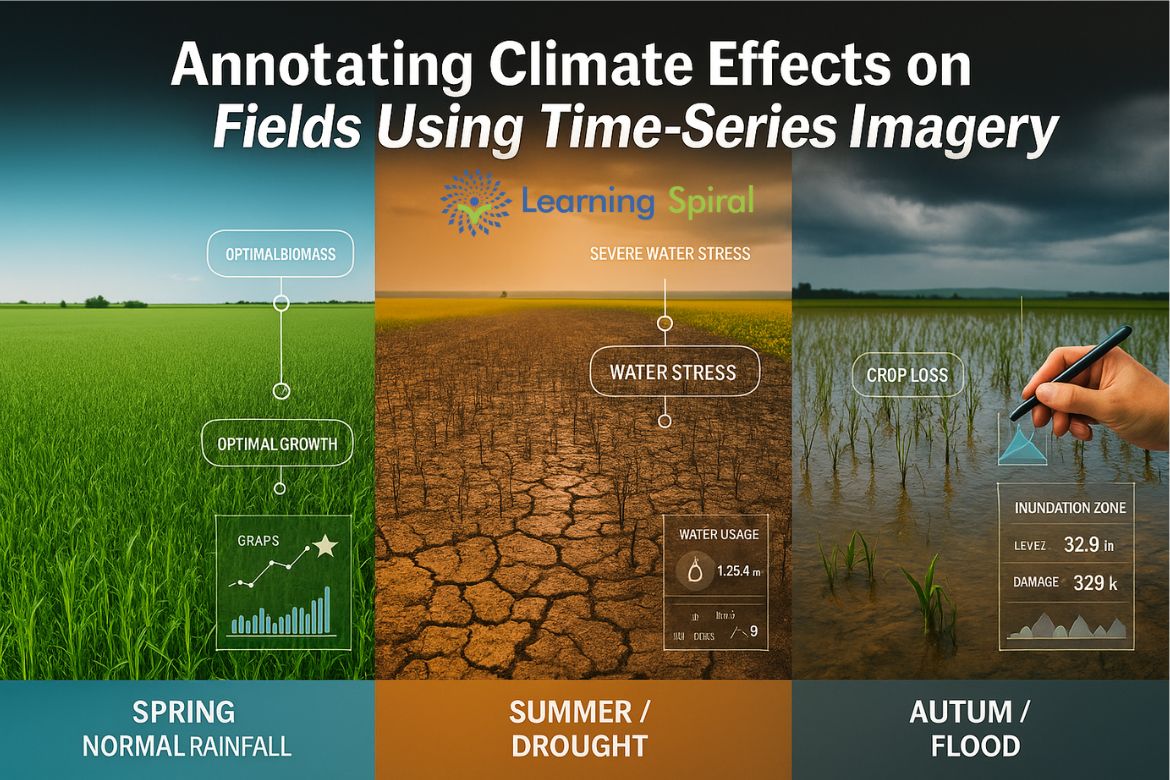
Annotating these images means labeling different features like:
- Crop growth stages
- Drought-affected areas
- Flood zones
- Soil moisture variations
- Vegetation health indices
This process trains AI and machine learning models to track how environmental conditions evolve over time. It bridges the gap between raw imagery and actionable climate insights — empowering precision agriculture, sustainability studies, and early warning systems.
In simpler terms, annotation converts large volumes of imagery into intelligent training data that helps machines “see” and “understand” the world’s changing landscapes.
Why It Matters in AI/ML Model Development
For machine learning models to deliver accurate climate predictions, they rely on labeled datasets that represent real-world conditions across time.
Here’s why this process is critical:
-
Improved Model Accuracy:
Time-series labeling helps models identify temporal patterns — like how vegetation reacts before, during, and after extreme weather events. -
Predictive Analytics for Agriculture:
Farmers can forecast yield fluctuations, irrigation needs, and potential crop losses using annotated satellite data. -
Environmental Monitoring:
Governments and research organizations can detect deforestation, soil degradation, and water scarcity trends with greater precision. -
Automation in Climate Research:
Annotated datasets reduce the time and cost of manual image analysis, enabling large-scale environmental AI systems.
With accurate annotation, AI models evolve from simple image recognition tools into intelligent climate monitoring systems capable of predicting and preventing damage before it occurs.
Challenges & Solutions
⚠️ Key Challenges
-
Data Volume: Time-series data often includes thousands of high-resolution images, requiring scalable annotation workflows.
-
Consistency: Maintaining accuracy across temporal datasets is difficult, as even small mislabels can distort model learning.
-
Complex Features: Identifying subtle climate patterns — like slight color shifts due to temperature change — demands domain expertise.
-
Integration: Aligning annotated data with climate models and geospatial analytics platforms can be complex.
💡 Practical Solutions
- Automated Pre-labeling: AI-assisted pre-annotation helps reduce human effort and accelerates dataset creation.
- Quality Control Loops: Double-blind verification ensures consistent accuracy across multiple annotators.
- Domain Training: Annotators trained in agritech and remote sensing ensure context-aware labeling.
- Scalable Tools: Cloud-based annotation platforms streamline large dataset handling without compromising security.
These combined approaches ensure that annotated time-series datasets remain reliable, detailed, and ready for deep learning integration.
How Learning Spiral AI Helps
At Learning Spiral AI, we deliver end-to-end annotation services tailored for AI and climate-focused applications.
Our specialized workflows include:
- Satellite & Drone Imagery Labeling: For tracking vegetation growth, soil erosion, and flood mapping.
- Time-Series Data Structuring: Organizing long-term visual datasets for temporal AI models.
- AI-Powered Quality Checks: Automated consistency checks to maintain high precision.
- Domain-Specific Expertise: Our annotators understand agritech, climate science, and remote sensing, ensuring contextually accurate data.
We help universities, research institutes, and environmental startups build smarter AI models with datasets that truly reflect climate variability. Whether it’s monitoring rainfall patterns or predicting drought impact, our scalable annotation services make it achievable.
Future Scope / Conclusion / CTA
As the world intensifies its focus on sustainable agriculture and environmental resilience, the demand for annotated climate data will continue to grow.
AI-driven time-series analysis is paving the way for smarter crop management, climate forecasting, and disaster prevention.
By partnering with Learning Spiral AI, organizations can access expertly labeled datasets that strengthen AI accuracy and decision-making.
Let’s shape a climate-smart future — one dataset at a time.
👉 Learn more about how Learning Spiral AI can power your next AI model with high-quality time-series imagery annotation.