
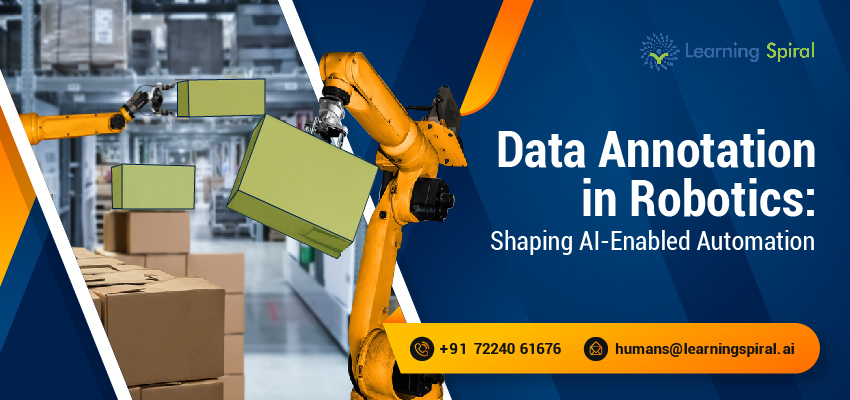
Robotics is one of the most attractive technological sectors in the world, and for good reason. The creation & development of robots designed to do our bidding and save time sounds like a blessing.
The rise of robotics and artificial intelligence (AI) promises a future of intelligent machines working alongside humans. However, for robots to truly become autonomous, they need to be trained on large amounts of labeled data. This is what we call data annotation. This critical step plays a central role in shaping the capabilities of AI-powered robots.
The Importance of Data Annotation in Robotics:
Just like any student needs well-structured information to learn, AI systems rely on properly labeled data for effective training. Data annotation involves meticulously labeling various types of data, such as images, videos, and sensor readings, with specific information. This “teaching” allows the AI to understand the nuances of the data and learn to perform tasks accurately.
In the context of robotics, data annotation plays a crucial role in enabling robots to:
- Perceive their surroundings: By annotating images and sensor data with details like object boundaries, robot arms can learn to identify and locate objects in their environment.
- Understand tasks and instructions: Annotating video data depicting specific tasks, like assembling products or navigating obstacles, helps robots understand the sequential steps involved and make decisions in real-time.
- Develop decision-making capabilities: Labeling data with information about safe and unsafe zones, potential hazards, and desired outcomes equips robots to make intelligent decisions based on their environment.
Types of Data Annotation in Robotics:
Different tasks require different types of data annotation. Here are some common approaches:
- Bounding boxes: Drawing boxes around objects in images and videos helps robots recognize and locate specific objects.
- Semantic segmentation: Pixel-level labeling identifies individual objects and their specific categories (e.g., chair, table) within an image.
- Pose estimation: Labeling the position and orientation of objects or body parts allows robots to understand the spatial relationships in their environment.
- Time series annotation: Attaching timestamps to sensor data enables robots to learn temporal sequences and respond dynamically to changes.
Impact on AI-Enabled Automation:
The quality and quantity of data annotation directly impact the effectiveness of AI-powered robots.
- Improved accuracy and efficiency: High-quality annotated data leads to more accurate and efficient robots, minimizing errors and maximizing productivity in automated tasks.
- Enhanced safety: Precisely labeled data helps robots understand safety protocols and avoid hazardous situations, ensuring safe operation alongside humans.
- Broader application of robotics: With better-trained robots, the scope of automation can expand to new, more complex tasks, transforming various industries.
Challenges and Future Trends:
Despite its importance, data annotation faces challenges:
- Cost and time: Manual annotation is labor-intensive and expensive, hindering the scalability of AI solutions.
- Data bias: Unbiased data is crucial, as biased data can lead to discriminatory or unfair outcomes in robot behavior.
- Evolving needs: As robots become more sophisticated, the need for even more complex and nuanced data annotations will arise.
Conclusion:
Data annotation serves as the foundation for AI-powered robots, shaping their capabilities and driving the future of automation. As the field evolves, overcoming existing challenges and embracing new technologies will be crucial in unlocking the full potential of robots and transforming various industries through intelligent automation.