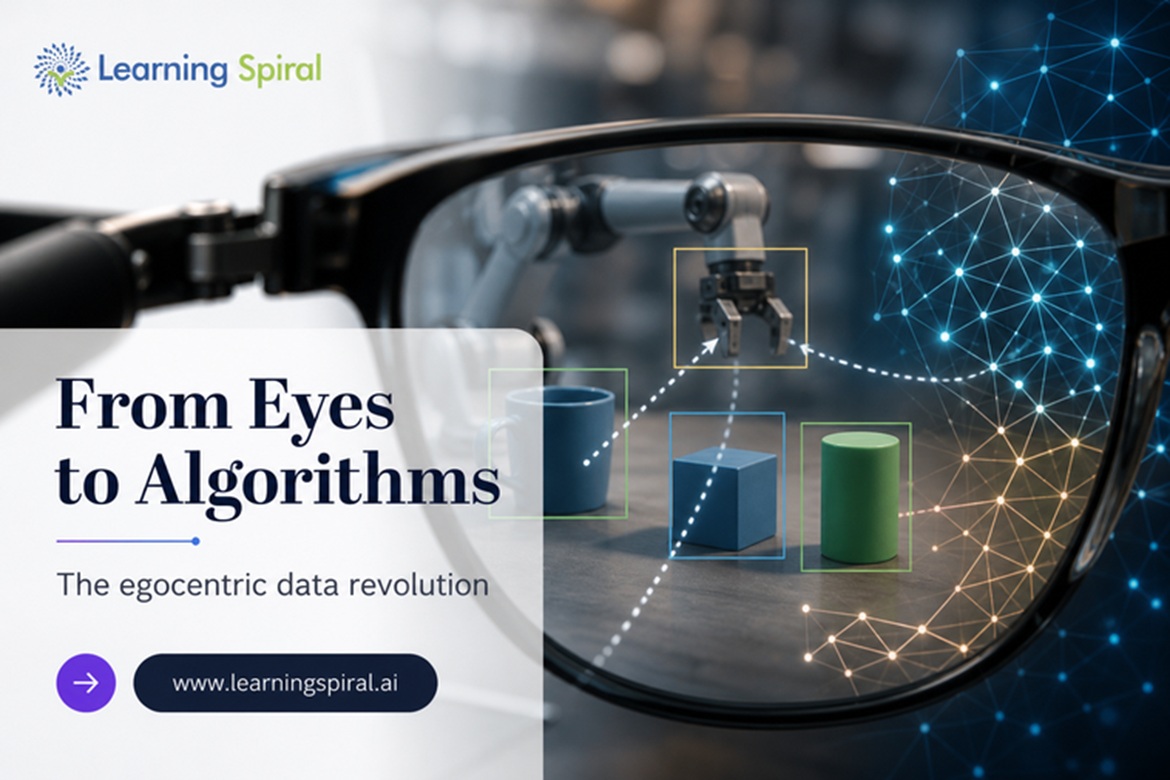
Imagine teaching a robot to make coffee — not by showing it a video from across the room, but through your own eyes as you reach for the mug. That’s egocentric data. And it’s changing how AI learns to move through the real world.
As a leading data annotation company, we’ve watched this shift happen in real time. First-person, wearable-camera datasets are no longer a research curiosity. They’re becoming the backbone of physical AI, robotics, and next-generation computer vision systems.
What Is Egocentric Data, Really?
Egocentric data is footage or sensor input captured from a first-person point of view — usually through head-mounted cameras, smart glasses, or body-worn sensors. Unlike traditional third-person video, it captures:
- Hand-object interactions in natural detail
- Gaze direction and attention patterns
- Real-world context, lighting, and motion blur
- Task sequences exactly as a human performs them
This is the raw material for Physical AI Data Collection — the discipline of teaching machines to act, not just observe.
Why the Shift From Third-Person to First-Person
For years, computer vision models trained mostly on static images or third-person video: security footage, stock photos, dashcams. That worked well for classification tasks. But it falls short when a robot or AI agent needs to understand how to do something — how to grip a tool, pour a liquid, or navigate a cluttered kitchen.
Egocentric datasets close that gap. They show the AI what a human sees and does at the moment of action. This matters most for:
- Robotics — teaching robotic arms and mobile robots natural manipulation
- Autonomous vehicles — understanding driver attention and reaction
- AR/VR systems — building context-aware wearable experiences
- Healthcare training tools — simulating procedures from a practitioner’s view
Where Data Annotation Fits In
Raw egocentric footage is messy. It’s shaky, occludes objects, and switches context constantly. Turning it into usable training data requires precise, structured labeling — and that’s where a specialized data labeling company earns its keep.
Typical annotation work on egocentric datasets includes:
- Bounding box annotation for objects in the wearer’s hands or field of view
- Action segmentation to mark the start and end of each task step
- Gaze and attention tagging to link where the eyes look with what happens next
- 3D point cloud annotation when depth sensors are involved
- Audio annotation for spoken instructions or ambient context
Because this footage is unpredictable, most teams rely on a strong Human in the Loop (HITL) process. Skilled annotators review edge cases, correct model predictions, and maintain consistency across thousands of hours of footage — something automated pipelines alone still can’t do reliably.
The Industries Feeling This Most
Egocentric data collection isn’t limited to robotics labs. It’s showing up across sectors:
- Retail — understanding how shoppers interact with products
- Logistics — training AI to track warehouse picking and packing motions
- Agriculture — capturing field-level tasks for autonomous equipment
- Sports and games — analyzing player movement from a first-person view
- Medical annotation — documenting procedural steps for training simulations
Each use case demands annotation partners who understand the nuance of first-person footage, not just generic image labeling.
What to Look for in an Annotation Partner
If your team is building or scaling an egocentric dataset, the annotation partner you choose matters as much as the data itself. Look for:
- Experience with image annotation for robotics and physical AI use cases
- A proven Human in the Loop quality process
- Support for multiple modalities — video, audio, LiDAR, and text
- Domain expertise across medical data annotation, retail, and autonomous systems
- Scalable teams that can handle high-volume annotation projects without sacrificing accuracy
Egocentric data is turning human experience into machine intelligence, one labeled frame at a time. As physical AI systems move from research labs into warehouses, hospitals, and homes, the demand for precise, human-reviewed AI training data services will only grow.
Choosing the right data annotation company isn’t just a vendor decision – it’s a foundation for how well your AI understands the physical world.
Ready to build your egocentric dataset the right way? Talk to our team about tailored image, video, and sensor annotation services built for physical AI and robotics.