As autonomous vehicles (AVs) continue to redefine transportation, the accuracy of the data used to train their AI models becomes increasingly critical. At the core of this training lies data annotation—the process of labeling data such as images, video, audio, and sensor inputs. However, even with automated tools, errors in annotation can compromise the performance and safety of AV systems. That’s where manual quality assurance (QA) steps in.
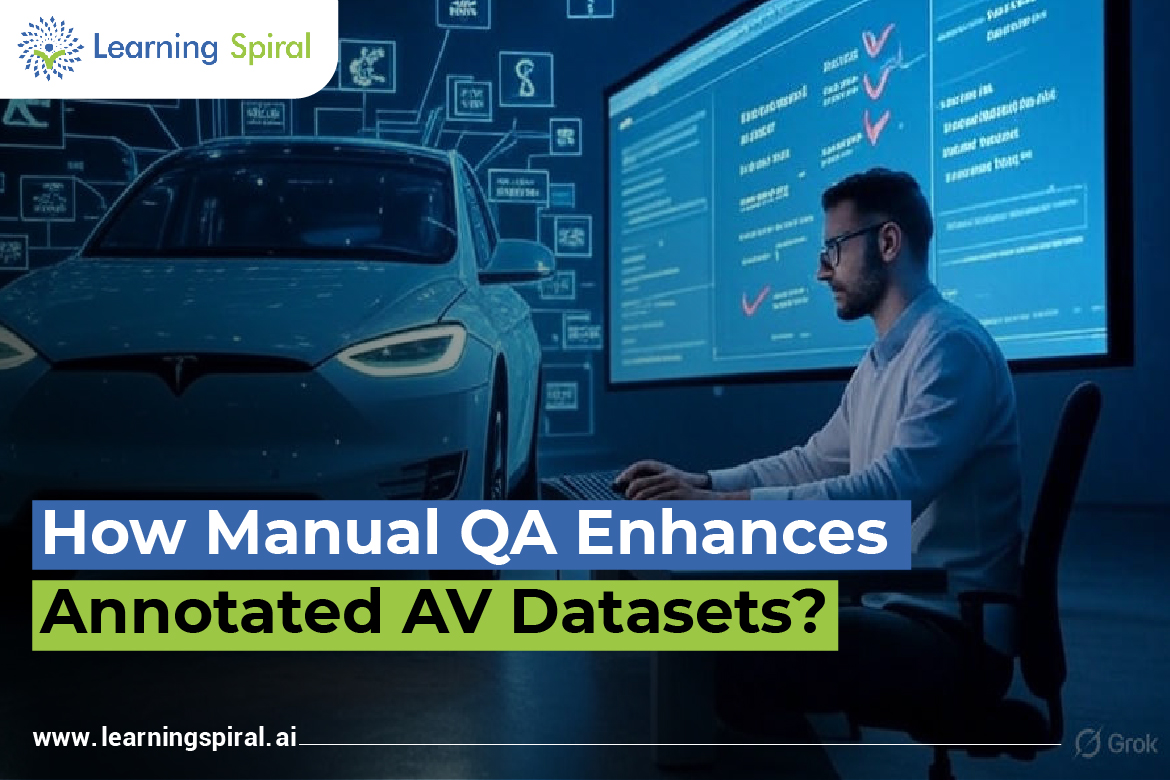
Manual QA is the process of reviewing annotated datasets to ensure each label is correct, consistent, and contextually accurate. Especially in autonomous vehicle datasets, which often include complex environments and edge cases, human oversight is indispensable. Mislabeling a pedestrian or misclassifying a traffic signal can lead to costly and dangerous AI errors.
From bounding box annotation for vehicles to image labeling of road signs, the accuracy of each element contributes to real-time decision-making for AVs. Manual QA helps detect inconsistencies that automated systems may overlook, such as partially hidden objects, low-light scenarios, or occluded pathways. By maintaining high annotation standards, it enhances the model’s ability to generalize across diverse environments.
At Learning Spiral AI, we understand that precision matters. That’s why we integrate manual QA into every data annotation pipeline, especially for industries like autonomous driving, robotics, and transportation. Our expert annotators and quality reviewers follow multi-layered protocols to validate annotations for video annotation, image annotation, Lidar data, and more.
Whether you’re building object detection systems or training navigation algorithms, our manual QA-backed data annotation services ensure your AV models perform safely and efficiently in real-world conditions.
Learning Spiral AI is your trusted partner in delivering high-quality, consistent, and scalable annotated datasets—the backbone of smarter, safer autonomous vehicles.