
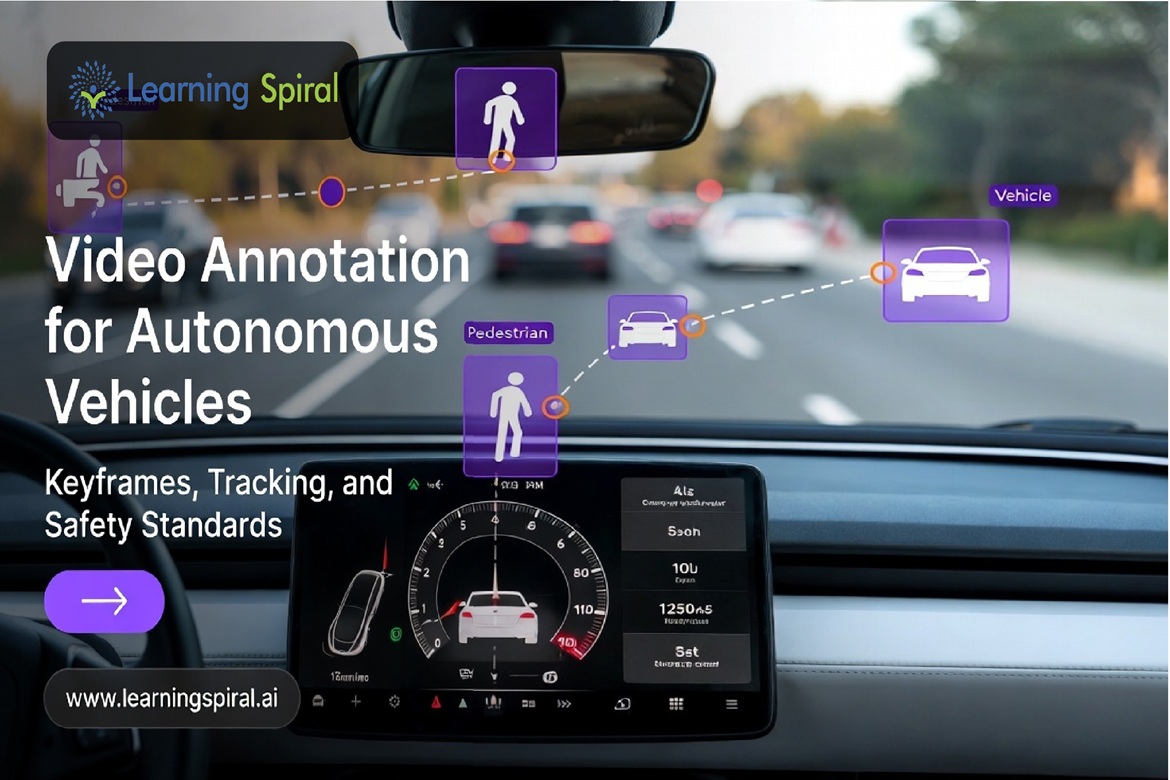
What happens when a self-driving car sees a pedestrian for one frame but loses track of them in the next?
For an autonomous vehicle, recognizing an object is only the beginning. The real challenge is understanding where that object is moving, whether it presents a potential hazard, and how its position changes over time.
This is where Video Annotation for Autonomous Vehicles becomes essential.
Autonomous driving systems rely on precisely labeled visual information to learn how to identify vehicles, pedestrians, cyclists, traffic signals, road boundaries, and unexpected obstacles. However, poorly labeled frames, inconsistent object IDs, or missing safety-critical events can weaken the quality of an AI training dataset.
At Learning Spiral AI, we help organizations transform complex visual data into structured datasets through Video Annotation, object tracking, and specialized data labeling services.
Let’s explore how keyframes, temporal tracking, and safety-focused annotation workflows help prepare reliable AI training data for autonomous mobility.
What Is Video Annotation for Autonomous Vehicles?
Video annotation is the process of assigning meaningful labels to objects, actions, and events across multiple frames of a video.
Unlike traditional image annotation, which captures information from a single image, video annotation preserves relationships over time.
Imagine an autonomous vehicle approaching a busy intersection. Its cameras capture vehicles changing lanes, pedestrians waiting to cross, bicycles moving between cars, and traffic signals changing colors.
A properly annotated video dataset can describe not only which objects are present but also how they move, interact, appear, disappear, and reappear.
According to the broader concept of Data Annotation, structured labels help machine learning systems learn meaningful patterns from raw data.
For autonomous vehicles, video annotation commonly involves bounding box annotation, object tracking, semantic segmentation, instance segmentation, lane marking, object attributes, and event labeling.
These labels support computer vision models responsible for perception and scene understanding, while downstream systems use perception outputs alongside other information to support driving decisions.
Why Is Video Annotation So Important for Self-Driving Cars?
Autonomous vehicles operate in environments that constantly change.
A pedestrian may suddenly cross the road. A motorcycle may emerge from behind a parked truck. Another vehicle may brake unexpectedly.
AI perception systems must recognize and interpret these situations using information collected across consecutive frames and, often, multiple sensors.
High-quality video annotation helps create training and evaluation datasets that capture these dynamic scenarios.
Understanding Movement Instead of Static Objects
Image labeling helps identify a cyclist. Video annotation additionally provides information about the cyclist’s changing position, direction, and interaction with surrounding traffic.
Maintaining Consistent Object Identity
Object tracking connects observations of the same object across frames. If a pedestrian moves behind a vehicle and later reappears, a well-designed annotation process applies consistent identity rules rather than arbitrarily treating the pedestrian as a new object.
Identifying Safety-Critical Events
Detailed temporal labels help document events such as abrupt braking, unsafe lane changes, pedestrian crossings, and near-collision situations.
Improving Dataset Coverage
A carefully designed dataset includes different lighting conditions, road types, traffic densities, weather conditions, and object categories.
The objective is not simply to generate more labels. It is to capture the right information, consistently, across the situations autonomous driving systems need to understand.
What Are Keyframes in Video Annotation?
A keyframe is a selected frame in a video that serves as an important reference for labeling an object, scene, or movement.
Instead of manually drawing every annotation from scratch, an annotation workflow may label important frames and use interpolation or automated tracking to propose labels between them.
For example, consider a pedestrian moving across the road in a 100-frame video sequence.
An annotator may accurately label the pedestrian at selected frames where the position, scale, direction, or visibility changes significantly.
An annotation tool can then estimate intermediate bounding boxes, which must be reviewed and corrected where necessary.
The broader principle of using selected frames to define changes over time is related to Keyframes, although keyframes used in annotation are not necessarily the same as video-compression keyframes.
How Should Keyframes Be Selected?
Effective keyframe selection should consider the complexity of the scene rather than relying only on a fixed time interval.
For relatively predictable motion, fewer manually annotated reference frames may be sufficient. However, complex situations require closer attention.
Important moments include sudden changes in object direction, partial occlusion, new objects entering a scene, objects leaving the camera view, rapid changes in apparent object size, and interactions at busy intersections.
Can Keyframe Annotation Reduce Labeling Effort?
Yes, when paired with reliable interpolation and human review.
Keyframe-based annotation can reduce repetitive manual drawing while maintaining quality. However, excessive gaps between keyframes may introduce inaccurate positions, missed objects, or identity inconsistencies.
For safety-sensitive datasets, efficiency must never come at the expense of essential ground-truth quality.
Object Tracking: Teaching AI to Follow Objects Across Frames
Object tracking is one of the most important components of autonomous vehicle video annotation.
It connects the same real-world object across successive frames using a persistent tracking identity.
For example, a white car appearing in frame 1 should retain its assigned object ID as it moves through subsequent frames, provided it remains the same tracked object.
This consistency helps create datasets for multiple-object tracking, motion analysis, and trajectory-related tasks.
Bounding Box Annotation and Tracking IDs
Bounding box annotation places rectangular coordinates around relevant objects such as cars, buses, trucks, motorcycles, bicycles, and pedestrians.
When combined with tracking IDs, these annotations represent an object’s location across time.
Handling Occlusion
An object may temporarily disappear behind another vehicle or roadside structure.
Annotation guidelines must define whether the object remains associated with its original tracking ID, when its position can be inferred, and when it should be marked as invisible or uncertain.
Tracking Objects Entering and Leaving the Scene
Vehicles and pedestrians can enter or leave the camera view at any moment.
Accurate labels record the visible portion of an object’s journey without inventing observations outside the available evidence.
Maintaining Temporal Consistency
Labels should follow stable classification rules across the video.
For example, the same vehicle should not alternate between the labels “car” and “truck” because of inconsistent interpretation between frames.
At Learning Spiral AI, our AV Annotation Services support autonomous driving datasets through relevant visual and sensor-based labeling capabilities.
Beyond Video: The Role of LiDAR Annotation and 3D Point Clouds
Camera footage provides valuable visual information, but autonomous driving datasets may also include LiDAR, radar, and other sensor inputs.
LiDAR captures spatial measurements that can be represented as three-dimensional point clouds. These measurements provide depth and geometric information about the surrounding environment.
Through LiDAR Annotation, raw point clouds can be transformed into structured data representing vehicles, pedestrians, road infrastructure, and other relevant objects.
3D Cuboid Annotation
3D cuboid annotation represents objects using three-dimensional boxes.
Depending on dataset requirements, these boxes describe attributes such as object position, size, and orientation.
3D Point Cloud Annotation
3D point cloud annotation assigns labels to objects or regions within spatial data.
This supports tasks involving 3D object detection, scene understanding, and robotic perception.
Sensor Fusion Annotation
When camera, LiDAR, and radar data are synchronized and calibrated, their annotations can support multimodal perception training.
Accurate alignment between sensors is important because inconsistent timing or coordinate transformations can create misleading ground truth.
Combining multiple sensor modalities can help developers train systems that interpret their environment using complementary sources of information.
What Safety Standards Matter in Autonomous Vehicle Data Annotation?
Safety is one of the central concerns in autonomous driving development.
However, it is important to distinguish between safety standards for vehicle systems and quality-control practices for annotation datasets.
Video annotation does not independently certify an autonomous vehicle as safe. It contributes to the evidence and data quality needed for training, evaluation, and validation.
ISO 26262 and Functional Safety
ISO 26262 addresses functional safety for automotive electrical and electronic systems.
Although it is not a dedicated annotation standard, its safety-oriented engineering principles make requirements traceability, verification, and systematic quality control relevant considerations for data-dependent automotive development.
ISO 21448 and Safety of the Intended Functionality
ISO 21448, commonly associated with Safety of the Intended Functionality (SOTIF), addresses risks that may arise from functional insufficiencies or reasonably foreseeable misuse, even when systems are operating without a conventional malfunction.
For perception-related machine learning, challenging scenarios and limitations in sensing or interpretation are particularly important.
High-quality annotation can support the development and assessment of datasets that represent relevant operating conditions.
Scenario Coverage and Edge Cases
Autonomous vehicle training data should represent more than normal traffic.
Useful scenarios may include:
- Pedestrians partially hidden behind parked vehicles
- Cyclists crossing intersections unexpectedly
- Heavy rain, fog, glare, and low-light conditions
- Construction zones and temporary traffic controls
- Emergency vehicles and unusual road users
- Complex merging, overtaking, and lane-changing situations
These scenarios should be labeled according to documented definitions and reviewed with appropriate care.
Traceability and Dataset Quality
A quality-focused annotation workflow should document dataset versions, labeling instructions, review decisions, and corrections.
Where required, audit trails can help teams investigate labeling errors and understand how training data was prepared.
The key principle is simple: safety-sensitive AI datasets require measurable quality, reliable review processes, and clear documentation—not just a high volume of annotations.
How Does Human in the Loop (HITL) Improve Video Annotation Accuracy?
Automated annotation tools can assist with object detection, interpolation, and tracking. However, these tools can make mistakes when scenes become crowded, objects overlap, or visual conditions deteriorate.
This is where Human in the Loop (HITL) becomes especially valuable.
Human reviewers can assess ambiguous classifications, correct tracking errors, refine boundaries, and verify critical events.
For example, an automated tracker may accidentally assign a pedestrian’s ID to another person when they pass close together.
A trained reviewer can inspect the surrounding frames, identify the likely identity switch, and correct the annotations according to the project guidelines.
HITL workflows are particularly useful for reviewing uncertain objects, validating automatically generated annotations, maintaining class consistency, and resolving difficult edge cases.
For enterprises managing large-scale annotation projects, human review provides an important quality-control layer alongside automation.
Common Video Annotation Mistakes That Can Affect AI Training
Even sophisticated labeling pipelines may encounter recurring problems.
Inconsistent tracking identities: The same physical object receives different IDs across frames, weakening the reliability of tracking ground truth.
Missing small or partially visible objects: Distant cyclists, partially occluded pedestrians, and small road obstacles are overlooked.
Inaccurate bounding boxes: Annotations fail to represent objects consistently, especially during motion or occlusion.
Incorrect temporal event boundaries: An event begins or ends at the wrong time, creating inconsistencies in event-detection training data.
Poor handling of uncertain cases: Annotators guess object classes or trajectories rather than following established uncertainty rules.
Insufficient quality assurance: Automated labels are exported without adequate validation against project requirements.
Reducing these errors requires clear annotation guidelines, trained reviewers, systematic quality checks, and appropriate sampling or full review for high-risk scenarios.
How to Build a High-Quality Autonomous Vehicle Annotation Workflow
A reliable workflow begins with understanding the intended machine learning task.
The annotation team should establish a clear taxonomy of objects, attributes, events, and tracking rules before large-scale production begins.
A representative pilot dataset can then test whether the instructions are unambiguous and whether the proposed tools support the required labeling precision.
During production, human annotators may combine manual labeling with AI-assisted interpolation, tracking, and segmentation.
Quality reviewers should evaluate temporal consistency, object identities, label completeness, localization quality, and adherence to the agreed guidelines.
Finally, the approved annotations should be exported in the required dataset format, accompanied by relevant quality records and version information.
This structured process helps organizations build a more dependable Dataset for Machine Learning, whether the use case involves vehicle perception, robotics, logistics automation, or intelligent transportation systems.
Why Choose Learning Spiral AI for Autonomous Vehicle Data Annotation?
Training advanced perception systems requires a dependable data annotation partner capable of handling complex visual and spatial data.
Learning Spiral AI provides professional data labeling and annotation services designed to help AI and machine learning teams prepare structured training datasets.
Our service capabilities include video annotation, object tracking, bounding box annotation, image annotation, LiDAR annotation, 3D point cloud labeling, and other computer vision data workflows.
As a Data Annotation Company serving AI development requirements, we combine trained human annotation teams with quality-focused workflows and scalable delivery capabilities.
For organizations comparing Data Labeling Companies in India or evaluating Computer Vision Companies in India for annotation support, the right partner should understand both the technical labeling task and the importance of consistent data quality.
Our broader Data Annotation Services support organizations working on AI training data across different modalities and applications.
Whether your requirements involve autonomous vehicle perception, robotics, or specialized annotation projects, Learning Spiral AI can help you prepare labeled datasets aligned with your project specifications.
Conclusion: Better Autonomous Driving AI Starts With Better Annotated Data
Autonomous vehicles must understand environments where objects, road conditions, and traffic behavior continuously change.
Video annotation makes these dynamic scenes more useful for AI development by connecting object recognition with movement, tracking, and temporal context.
Keyframe selection helps streamline labeling. Consistent object tracking preserves identity across frames. LiDAR annotation adds spatial information. Safety-focused quality reviews strengthen the reliability and traceability of the resulting datasets.
Together, these practices support the development of more capable perception models, although real-world vehicle safety still depends on extensive testing, validation, system engineering, and regulatory requirements.
The future of autonomous mobility needs more than intelligent algorithms. It needs carefully prepared training data.
Accelerate Your Autonomous Vehicle AI Projects With Learning Spiral AI
Looking for professional Video Annotation, Image Annotation, LiDAR Annotation, or AI Training Data Services?
Partner with Learning Spiral AI for scalable data labeling and annotation support tailored to your computer vision requirements.
Let’s turn complex data into meaningful intelligence for the next generation of autonomous systems.