In the age of intelligent voice assistants, real-time subtitles, and automated call analytics, audio data has become one of the most valuable raw inputs for machine learning. Yet, one fundamental challenge persists: raw audio is unusable for AI without careful transcription and timestamp annotation.
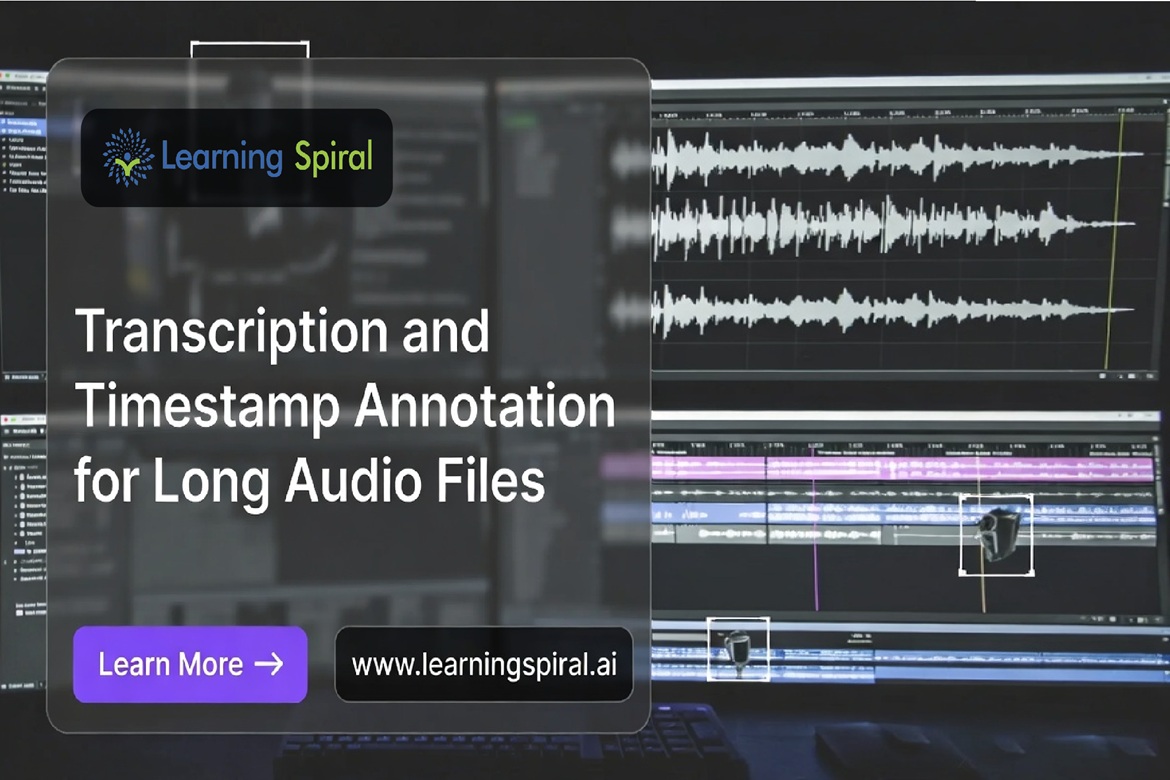
Transcription alone converts spoken words into text. But timestamp annotation goes further – it maps every word, phrase, or speaker turn to a precise moment in the audio timeline. This granularity is essential for training models that need to understand not just what was said, but when and by whom.
For use cases like podcast analysis, legal depositions, medical dictations, and customer service recordings, millisecond-level precision directly determines the reliability of downstream AI outputs.
Annotating short audio clips is relatively straightforward. Long-form content – sometimes spanning hours – introduces a different set of problems:
- Speaker diarisation: identifying and labelling multiple voices across lengthy recordings
- Overlapping dialogue: distinguishing simultaneous speech without losing context
- Background noise interference: annotators must flag non-speech segments accurately
- Domain-specific vocabulary: medical, legal, or technical terms require specialised annotators
- Consistency at scale: ensuring uniform annotation standards across large machine learning datasets
“High-quality annotation is not just data—it’s the foundation of reliable AI systems.”
Organisations investing in professional audio annotation services see measurable improvements in model performance. Structured pipelines—covering segmentation, speaker tagging, noise classification, and timestamp mapping—transform raw recordings into structured, model-ready assets.
Teams working with experienced AI data solution partners often achieve faster model accuracy and quicker deployment cycles. This is especially true in NLP-heavy verticals where the cost of mislabelled training data is compounded at every iteration.
Text annotation and audio annotation are increasingly interconnected. Once audio is transcribed, the text layer requires its own labeling—sentiment tagging, intent classification, entity recognition. A complete annotation pipeline handles both layers cohesively.
Learning Spiral AI specialises in end-to-end data annotation services including audio transcription, timestamp labeling, and text annotation. With multilingual capabilities and domain-trained annotators, the team enables AI companies to build more accurate, faster-learning speech and language models.
Whether you’re developing voice interfaces, call centre automation, or medical transcription tools, scalable and precise annotation is the differentiator between a model that performs and one that falls short.
Explore Learning Spiral AI’s audio annotation and data labeling services—or connect with the team to discuss your specific project requirements.