Why Emergency Call Annotation Is a Critical AI Challenge
Public safety agencies are increasingly turning to AI-powered dispatch and triage systems to manage growing call volumes. Whether it is predicting emergency severity, routing resources, or detecting stress indicators in a caller’s voice, these systems depend entirely on the quality of their underlying machine learning datasets.
Yet annotating emergency calls is far more complex than standard audio transcription. The data is noisy, emotionally charged, linguistically diverse, and time-sensitive. Without expert-level audio annotation and text annotation, even the most sophisticated models will fail when it matters most.
What Makes Emergency Call Data Annotation So Complex?
Unlike typical call center datasets, emergency audio introduces several unique annotation challenges:
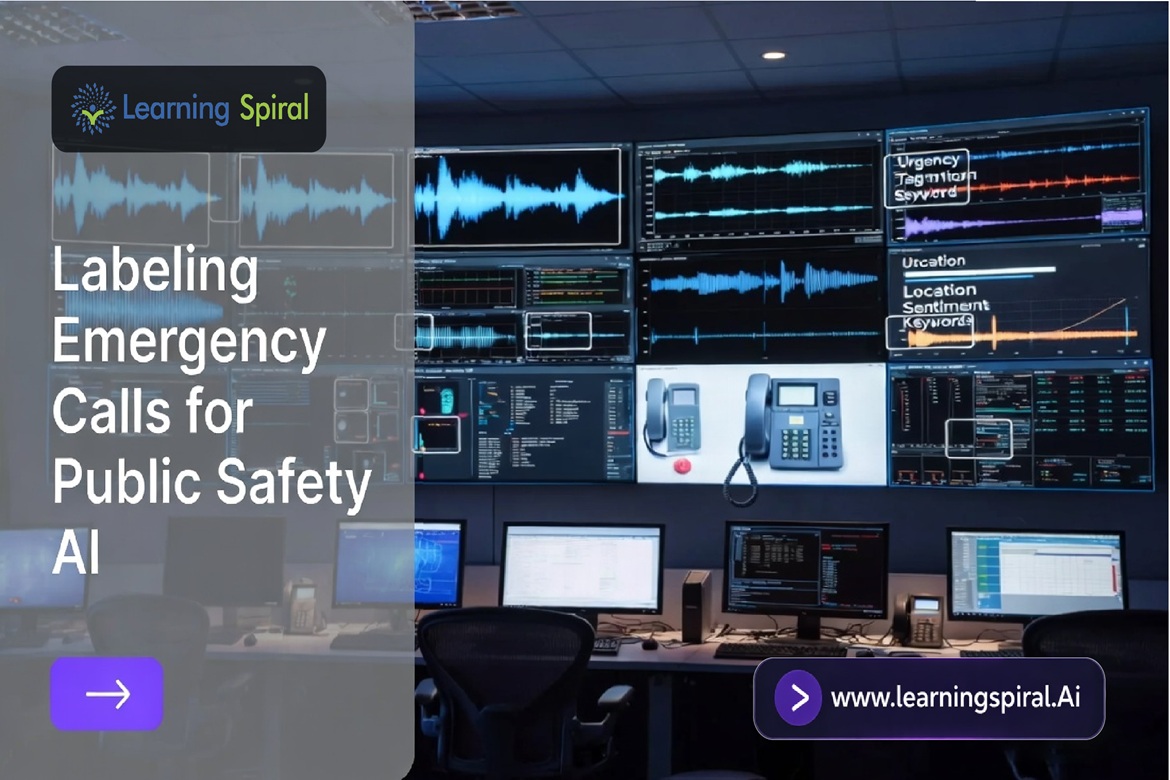
- Multi-speaker diarization — distinguishing between dispatcher, caller, and background voices accurately
- Emotion and urgency tagging — labeling distress levels, panic, or calm that signals emergency severity
- Dialect and code-switching — handling regional accents, multilingual speakers, and informal language
- Noise classification — annotating ambient sounds (traffic, gunshots, alarms) as contextual signals for computer vision and AI triage models
- Temporal event labeling — marking the precise moment a threat is identified within the audio timeline
How Accurate Labeling Improves Public Safety AI Models
The performance of any NLP or speech-based AI model is directly tied to its training data. When data labeling is done with precision and domain knowledge, AI systems can:
- Distinguish life-threatening calls from lower-priority incidents with greater accuracy
- Reduce response time through faster, automated triage recommendations
- Improve accessibility by accurately processing non-native or speech-impaired callers
- Continuously learn from annotated edge cases that improve model robustness over time
Organizations that partner with an experienced data annotation company gain access to structured workflows, quality benchmarks, and domain-trained annotators — all of which translate directly into better model performance at deployment.
The Role of a Specialized AI Data Partner
Building reliable public safety AI requires more than raw data — it requires intelligent annotation pipelines. Learning Spiral AI brings together expertise across audio annotation, text annotation, and video annotation to support agencies and AI developers building next-generation emergency response tools.
From speech transcription and speaker labeling to sentiment tagging and multi-modal datasets, teams working with an experienced AI data solutions provider consistently achieve faster model accuracy, shorter deployment cycles, and greater confidence in real-world performance.
The annotation layer is where public safety AI either earns trust — or fails it. Learning Spiral AI ensures that layer is built right.
Building the Future of Emergency AI — One Label at a Time
As AI becomes embedded in how emergencies are detected, dispatched, and resolved, the stakes for data quality have never been higher. The technology is ready. The question is whether the training data behind it is ready too.
If your team is building public safety AI or exploring scalable image annotation services, audio labeling, or multimodal dataset creation, connect with a partner who understands both the technical requirements and the human stakes involved.