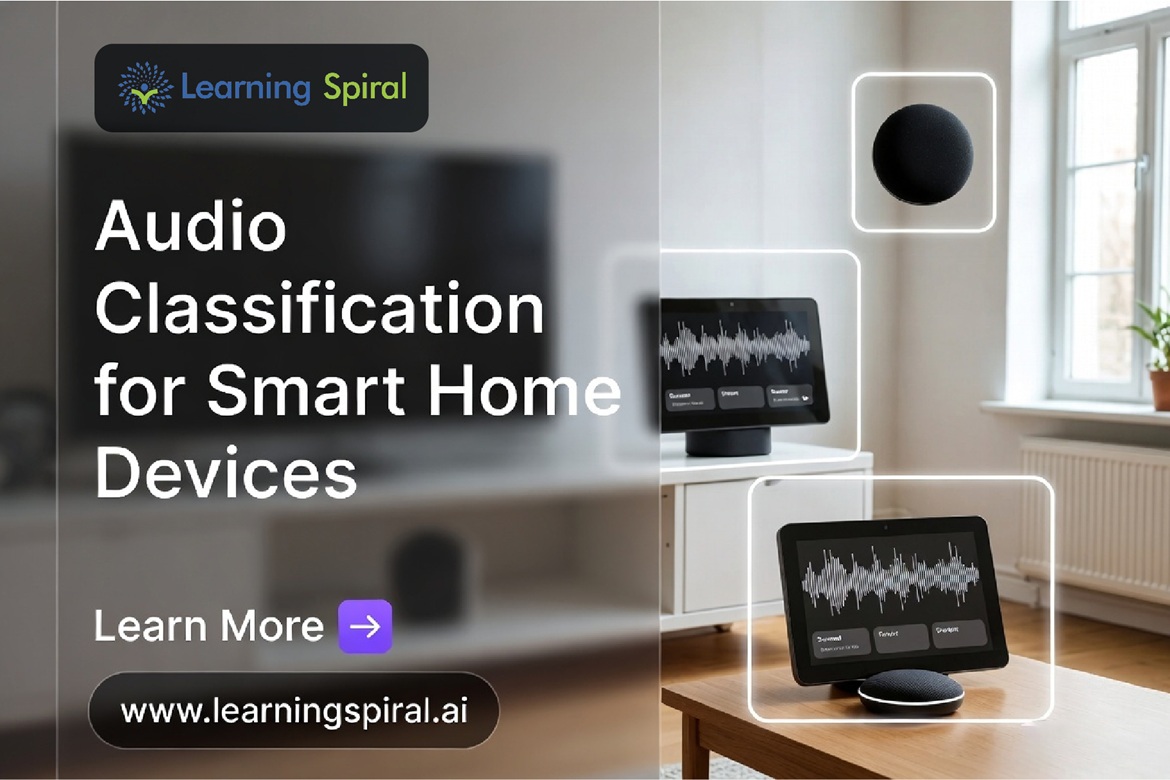
The smart home of today is not just voice-activated — it is sound-aware. From security cameras that distinguish a breaking window from a dropped plate, to baby monitors that detect a cry versus a cough, modern smart home devices must process, classify, and respond to a vast range of sounds in real time.
What makes this possible is not just powerful hardware or clever algorithms. It is high-quality, precisely labeled training data — and at the core of that sits audio annotation.
What Is Audio Annotation and Why Does It Matter?
Audio annotation is the process of identifying, labeling, and categorizing sound events within raw audio files to create machine learning datasets that AI models can learn from.
For smart home devices, this means teaching a model to reliably differentiate between:
- A smoke alarm versus a TV playing an action movie
- A child’s cry versus background conversation
- A wake word spoken with different accents, tones, and noise levels
- Mechanical fault sounds in HVAC systems versus normal operation
Without accurate audio annotation, even the most sophisticated model will misclassify, misfire, or fail — creating frustrating and sometimes dangerous outcomes for end users.
The Annotation Pipeline Behind Smart Home AI
Building production-ready audio models for smart home applications requires a structured data labeling workflow — not just basic transcription. A professional approach typically includes:
- Sound event detection with precise start and end timestamps
- Multi-label classification for overlapping or simultaneous audio events
- Environment and acoustic tagging — bedroom, kitchen, outdoor, high-noise
- Speaker diarization and accent/dialect coverage for voice-triggered devices
- Noise-injected and reverb-affected audio labeling for real-world robustness
- Inter-annotator agreement scoring to ensure labeling consistency across large datasets
Each layer adds accuracy. Skipping even one can introduce model bias that only surfaces after deployment.
“High-quality annotation is not just data — it is the foundation of reliable AI systems.”
Why AI Teams Partner with Specialist Data Annotation Companies
In-house annotation at scale is expensive, slow, and difficult to quality-control. This is why leading smart home AI teams work with dedicated data annotation companies that offer the domain expertise, annotator training, and QA infrastructure needed to deliver consistent, large-scale datasets.
Organizations working with experienced AI data solutions partners consistently report faster model iteration cycles, lower rework costs, and stronger real-world performance compared to teams managing annotation internally.
Learning Spiral AI brings exactly this capability — scalable, reliable audio annotation alongside image annotation services, video annotation, text annotation, and computer vision dataset solutions — all delivered under rigorous quality frameworks built for production AI.
Whether you are building wake word detection, ambient sound recognition, or full multi-modal home automation intelligence, the path to a reliable product starts with one decision: choosing the right annotation partner.
Ready to Build Smarter Smart Home AI?
Explore Learning Spiral AI’s end-to-end data labeling and AI data solutions — purpose-built for teams that cannot afford to compromise on training data quality.