
What This Article Covers
- What data annotation actually means (definition + simple explanation)
- Why annotation is the backbone of every AI/ML model
- Types of data annotation (image, video, text, audio, 3D)
- Manual vs. AI-assisted annotation — a side-by-side comparison
- Step-by-step: how the annotation process works
- Industry use-cases across sectors
- Common challenges beginners should know about
- FAQs answering the most-searched questions on data annotation
What is Data Annotation?
Data annotation is the process of labeling raw data – images, videos, text, or audio – so that machine learning models can recognize patterns and make accurate predictions. In simple terms, it’s how you “teach” an AI what something is, whether that’s tagging a stop sign in a photo, marking sentiment in a customer review, or transcribing spoken words. Without this labeled data, algorithms have no reference point to learn from.
Every industry now betting on artificial intelligence – from autonomous vehicles to healthcare diagnostics – depends on this unglamorous but foundational step. According to industry estimates, data scientists spend a significant share of their project time on data preparation and labeling tasks before a model ever begins training.
Why Does Data Annotation Matter So Much?
Machine learning models don’t understand the world the way humans do. A neural network can’t inherently tell the difference between a cat and a dog – it learns that distinction only after being shown thousands of correctly labeled examples. This is why annotation quality directly determines model accuracy.
A few reasons annotation is non-negotiable in AI development:
- It creates ground truth. Labeled data becomes the reference an algorithm is trained and evaluated against.
- It reduces bias. Diverse, carefully annotated datasets help prevent skewed or discriminatory model outputs.
- It improves real-world reliability. Well-labeled edge cases (poor lighting, occlusion, accents, sarcasm in text) make models more robust outside the lab.
- It accelerates deployment. Clean, consistent annotation reduces the retraining cycles needed before a model is production-ready.
High-quality annotation is not just data – it’s the foundation of reliable AI systems, and organizations working with experienced AI data solution partners often achieve faster model accuracy and shorter deployment timelines as a result.
Types of Data Annotation
Different AI applications require different annotation formats. Here’s a breakdown beginners should know:
1. Image Annotation
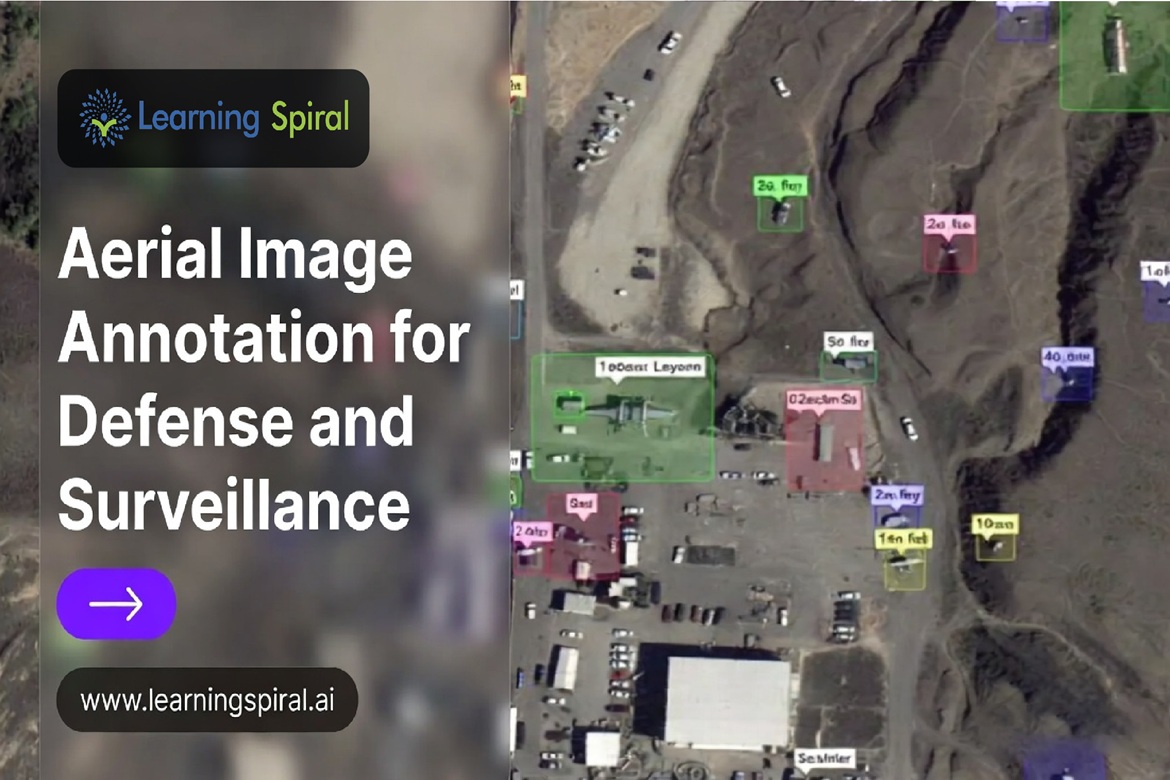
Used heavily in computer vision, image annotation includes bounding boxes, polygons, semantic segmentation, and keypoint annotation. It powers use-cases like retail shelf analysis, agricultural crop monitoring, and aerial imagery interpretation.
2. Video Annotation
Frame-by-frame labeling used in surveillance systems, sports analytics, and autonomous vehicle perception, where objects need to be tracked continuously across motion.
3. Text Annotation
Includes named entity recognition, sentiment tagging, intent classification, and part-of-speech tagging – the backbone of NLP applications like chatbots and search engines.
4. Audio Annotation
Covers transcription, speaker diarization, and sound event tagging, commonly used in voice assistants and call-center analytics.
5. 3D Point Cloud / LiDAR Annotation
Used primarily in autonomous vehicles and robotics, this involves labeling objects in three-dimensional space captured by LiDAR sensors.
Manual vs. AI-Powered Data Annotation
| Aspect | Manual Annotation | AI-Assisted Annotation |
|---|---|---|
| Accuracy | High, especially for nuanced/edge cases | Good, but may need human review |
| Speed | Slower, labor-intensive | Faster on large-volume datasets |
| Cost | Higher per-label cost | Lower at scale, but requires setup |
| Best For | Complex, ambiguous, or sensitive data (medical, legal) | Repetitive, high-volume, well-defined tasks |
| Human Oversight | Built into the process | Still required for quality control |
In practice, most production-grade AI data solutions use a hybrid approach — AI pre-labeling followed by human review — to balance speed with accuracy.
How the Data Annotation Process Works
For beginners, here’s a simplified step-by-step view of a typical annotation project:
- Data collection – Raw, unlabeled data is gathered from the relevant source (sensors, cameras, documents, call logs, etc.)
- Guideline creation – Clear labeling instructions and taxonomies are defined so annotators apply consistent standards
- Annotation – Human annotators (sometimes aided by AI tools) label the data according to guidelines
- Quality review – A second layer of reviewers checks for labeling errors, inconsistencies, or missed edge cases
- Validation & feedback loop – Labeled data is validated against model performance, and guidelines are refined if needed
- Delivery – Final annotated datasets are exported in the model-ready format (COCO, YOLO, Pascal VOC, JSON, etc.)
Industry Use-Cases of Data Annotation
- Autonomous vehicles: Bounding boxes and 3D point cloud annotation help self-driving systems detect pedestrians, vehicles, and lane markings
- Healthcare: Medical data annotation supports diagnostic imaging models (X-rays, MRIs, pathology slides)
- Retail: Image annotation for retail enables shelf-stock detection and customer behavior analysis
- Agriculture: Image annotation for agriculture helps identify crop health, pest detection, and yield estimation
- Logistics: Image annotation for logistics supports package sorting, damage detection, and warehouse automation
- Sports & Media: Image annotation for sports and games powers player tracking and automated highlight generation
Common Challenges Beginners Should Know About
- Inconsistent labeling across annotators without clear guidelines
- Class imbalance — too many examples of common objects, too few of rare ones
- Scalability — manually labeling millions of data points is time- and cost-intensive
- Domain expertise gaps — fields like medical annotation require trained specialists, not general annotators
- Data privacy — sensitive data (medical, financial, biometric) requires strict handling protocols
This is exactly why many teams choose to work with a dedicated data annotation company rather than building an in-house pipeline from scratch — it shortens the learning curve and reduces costly rework.
Frequently Asked Questions
1. What is data annotation in simple terms? Data annotation is the process of labeling raw data (images, text, audio, or video) so machine learning models can learn to recognize patterns and make predictions.
2. Why is data annotation important for AI models? Because AI models learn from examples, not instructions. Accurate labels act as the “answer key” that teaches a model what correct output looks like.
3. What are the main types of data annotation? The main types include image annotation, video annotation, text annotation, audio annotation, and 3D/LiDAR point cloud annotation.
4. Is data annotation done manually or by AI? Both. Many modern workflows use AI-assisted pre-labeling combined with human review to balance speed, cost, and accuracy.
5. Who needs data annotation services? Any organization building or fine-tuning machine learning models — including those in autonomous vehicles, healthcare, retail, agriculture, and logistics — needs annotated training data.
Explore Data Annotation Solutions
Understanding data annotation is the first step — implementing it well is what separates reliable AI models from unreliable ones. If you’re exploring data labeling and annotation services for your next ML project, explore Learning Spiral AI’s services to see how a structured, quality-first annotation process can support your goals. You can also learn more about their approach or connect directly with their team for solutions tailored to your dataset.