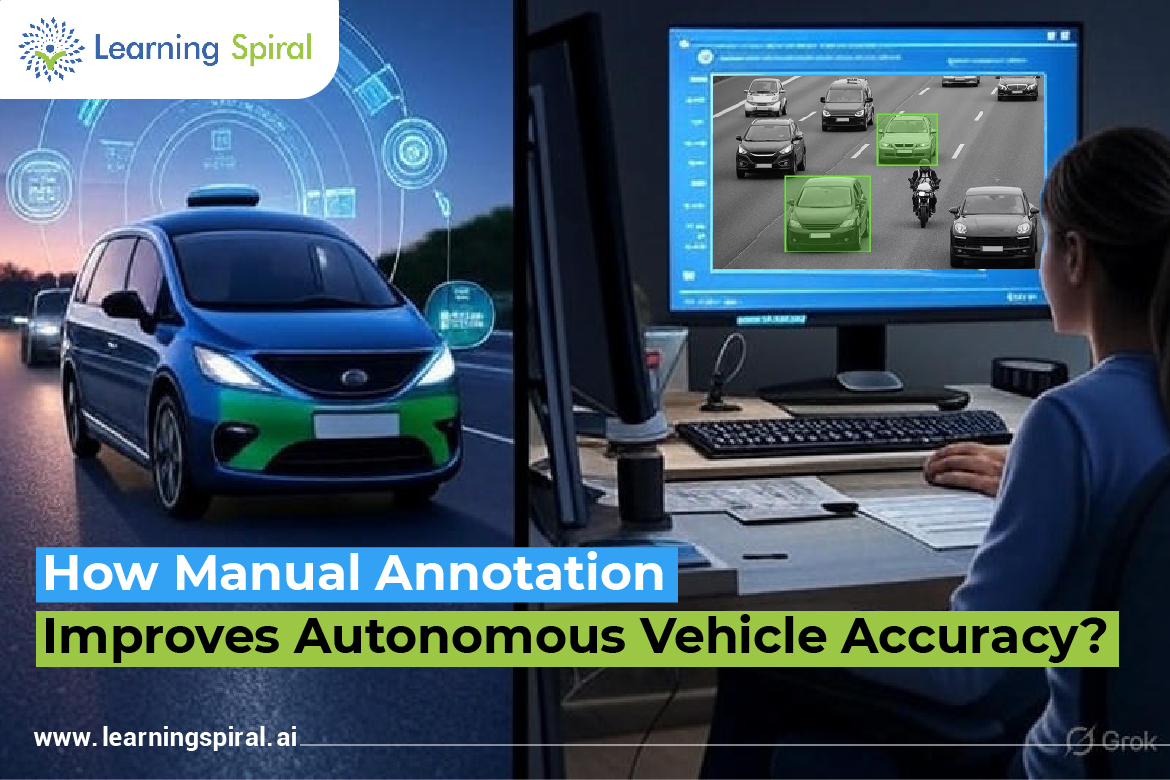
As autonomous vehicles (AVs) edge closer to mainstream adoption, the need for high-quality annotated data becomes critical. While automation is integral to AVs, the foundation of their success lies in manual annotation — a precise, human-led process that helps these systems understand and interpret the real world.
In the context of autonomous vehicles, manual annotation refers to the detailed labeling of objects like pedestrians, vehicles, traffic signs, and road lanes in images or videos. These annotations are used to train machine learning models to detect, classify, and react to objects in real-time driving scenarios. Manual annotation ensures that the edge cases — like unusual weather, roadblocks, or sudden pedestrian movement — are accurately captured, something automated tools often miss.
Key annotation types for AV datasets include bounding box annotation, image labeling, video annotation, and semantic segmentation. These annotation methods help self-driving algorithms learn with precision, leading to improved object detection, safer navigation, and fewer system errors on the road.
At Learning Spiral AI, we specialize in providing data annotation services tailored for the automotive industry. Our expert annotators handle complex datasets with utmost accuracy, ensuring your AV models receive the detailed, consistent, and high-quality input they need to perform flawlessly.
We offer a full suite of services including manual data annotation, image annotation, video annotation, and text annotation — all powered by quality control mechanisms and scalable workflows. Whether you’re developing Level 2 driver assistance systems or working toward fully autonomous Level 5 vehicles, Learning Spiral AI is your trusted partner in building reliable training datasets.
Manual annotation may seem labor-intensive, but its value in increasing AV performance, reducing bias, and addressing real-world unpredictability is unmatched. When precision drives innovation, Learning Spiral AI ensures your autonomous systems are always in the right lane.