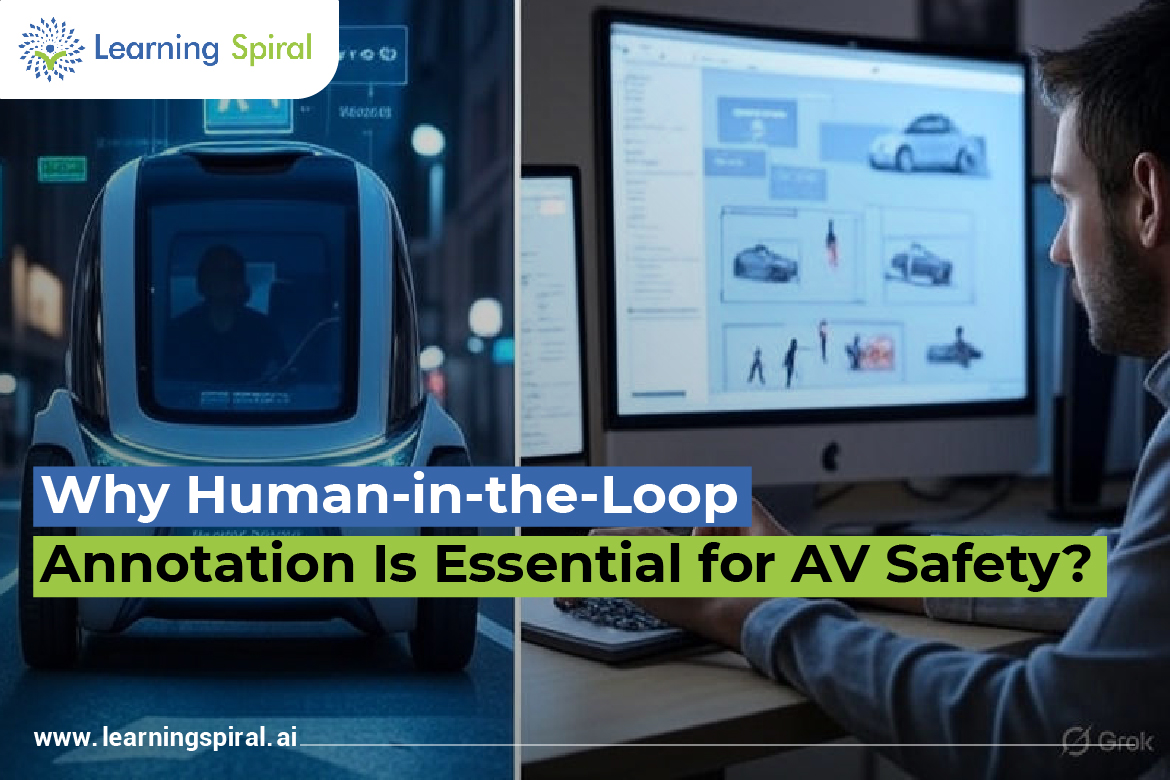
The future of transportation is autonomous. But before self-driving cars can fully operate without human intervention, they must be trained on vast amounts of highly accurate data. This is where Human-in-the-Loop (HITL) annotation becomes crucial for ensuring autonomous vehicle (AV) safety.
In the world of AI and machine learning, data annotation is the foundation that drives model performance. While automation tools and AI-assisted labeling have improved, they are still not flawless—especially when it comes to complex edge cases encountered on real roads. HITL annotation introduces human oversight at key stages of the annotation process, ensuring that every bounding box, image labeling, video annotation, or object detection is accurate, contextual, and reliable.
For autonomous vehicles, safety depends on how well a model interprets its environment. From identifying pedestrians and cyclists to reading traffic signs and reacting to unpredictable scenarios, the role of accurate data labeling becomes non-negotiable. A single mislabel could lead to a wrong decision, risking lives. HITL systems bring a feedback loop where annotators review, correct, and validate the outputs—bridging the gap between automation and precision.
At Learning Spiral AI, we specialize in human-in-the-loop data annotation services for industries like automotive, robotics, and surveillance. Our expert annotators work alongside intelligent tools to provide high-quality annotations for autonomous vehicle datasets, including LiDAR annotation, bounding boxes, semantic segmentation, and more. We understand that AV development demands not just data—but dependable, safety-critical insights.
With a strong focus on accuracy, scalability, and industry-specific requirements, Learning Spiral AI empowers autonomous systems to make safer, smarter decisions. We’re not just annotating data—we’re enabling the future of mobility.