
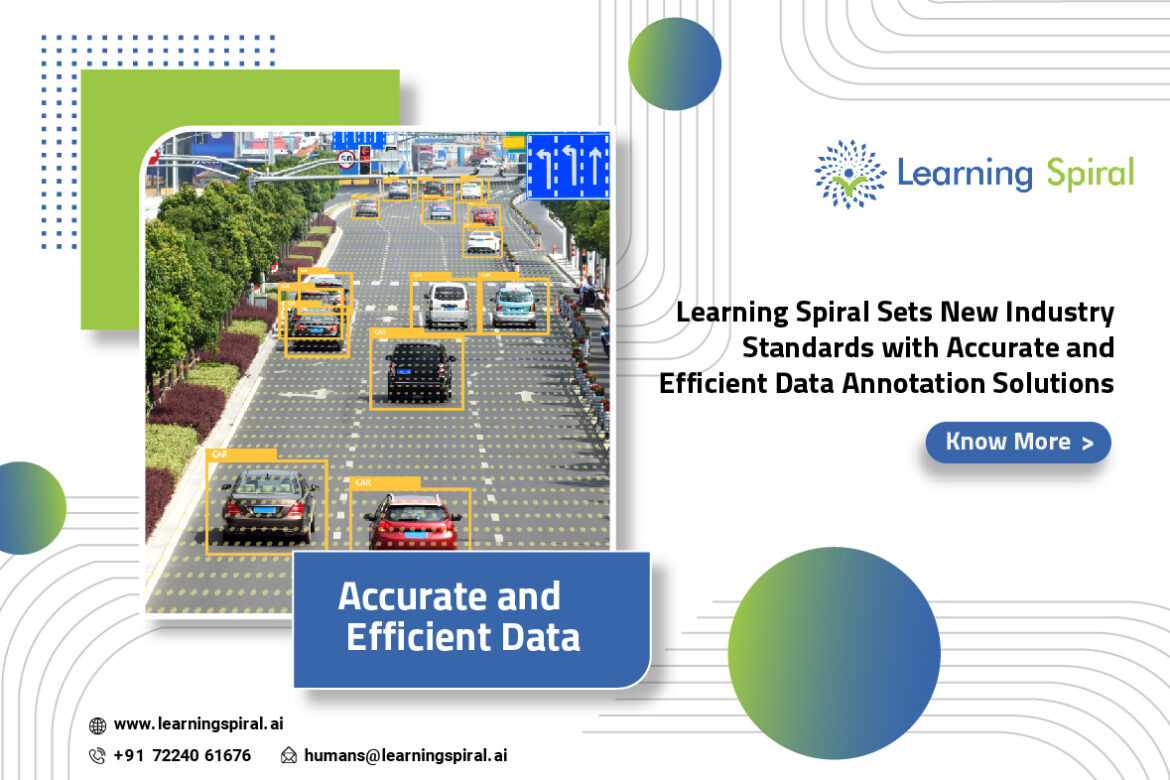
From healthcare and education to retail and manufacturing, accurate and efficient data annotation is the cornerstone of building intelligent systems. These advances would play a crucial role in driving progress and improving lives.
Amidst all this, inaccurate or poorly labeled data can lead to biased models, flawed decision-making, and, ultimately, negative consequences. This is where data annotation comes in – the meticulous process of labeling and classifying data to make it machine-readable.
Bringing a major front in the sector, Learning Spiral Pvt. Ltd. has been showcasing impressive data annotation solutions and raising industry standards for years. Let’s see what new features the firm has to offer in the field:
1. Active Learning:
This AI-powered technique prioritizes the most informative data points for annotation. This strategy helps in reducing the overall workload while ensuring high model accuracy.
Imagine an AI model learning to identify different types of fruit. Active learning would select ambiguous images, like a green apple vs. an orange, for human annotation, significantly improving the model’s ability to differentiate between similar objects.

2. Semi-supervised Learning:
This approach utilizes a combination of labeled and unlabeled data to train models. By leveraging pre-trained AI models and human expertise for the most critical data points, semi-supervised learning can significantly scale annotation efforts.
Think of it as having a seasoned chef guide a new apprentice. The chef provides initial instructions and feedback, allowing the apprentice to learn and eventually handle simpler tasks independently.
3. Collaborative Annotation:
Tools like real-time annotation platforms and shared workspaces enable teams of annotators to work together seamlessly. This not only speeds up the process but also fosters consistency. Alongside, it also reduces errors through peer review and collaborative decision-making.
Imagine a team of medical professionals annotating X-rays. Collaborative annotation allows them to discuss and agree on subtle details, leading to more accurate diagnoses.
4. Various Kinds of Automation:
AI-powered tools are automating repetitive tasks like image segmentation and text classification, freeing up human annotators for more complex tasks. This not only improves efficiency but also reduces costs and minimizes human bias.
Imagine a robot sorting through mountains of customer emails, automatically classifying them based on sentiment and keywords, hence allowing human agents to focus on resolving critical issues.
5. Data Quality Management:
Robust quality control measures are crucial for ensuring the accuracy and reliability of annotated data. Tools like data validation dashboards and AI-powered anomaly detection algorithms help identify and address inconsistencies and errors before they impact model performance.
Think of it as having a quality control inspector ensuring every product meets specifications before it reaches the market.
Conclusion
As these trends continue to evolve, Learning Spiral Pvt. Ltd., in the data annotation industry, is poised to play a pivotal role in unlocking the full potential of AI and shaping the future. For more insight into the many services and tools provided by the tech firm, visit the official website.